

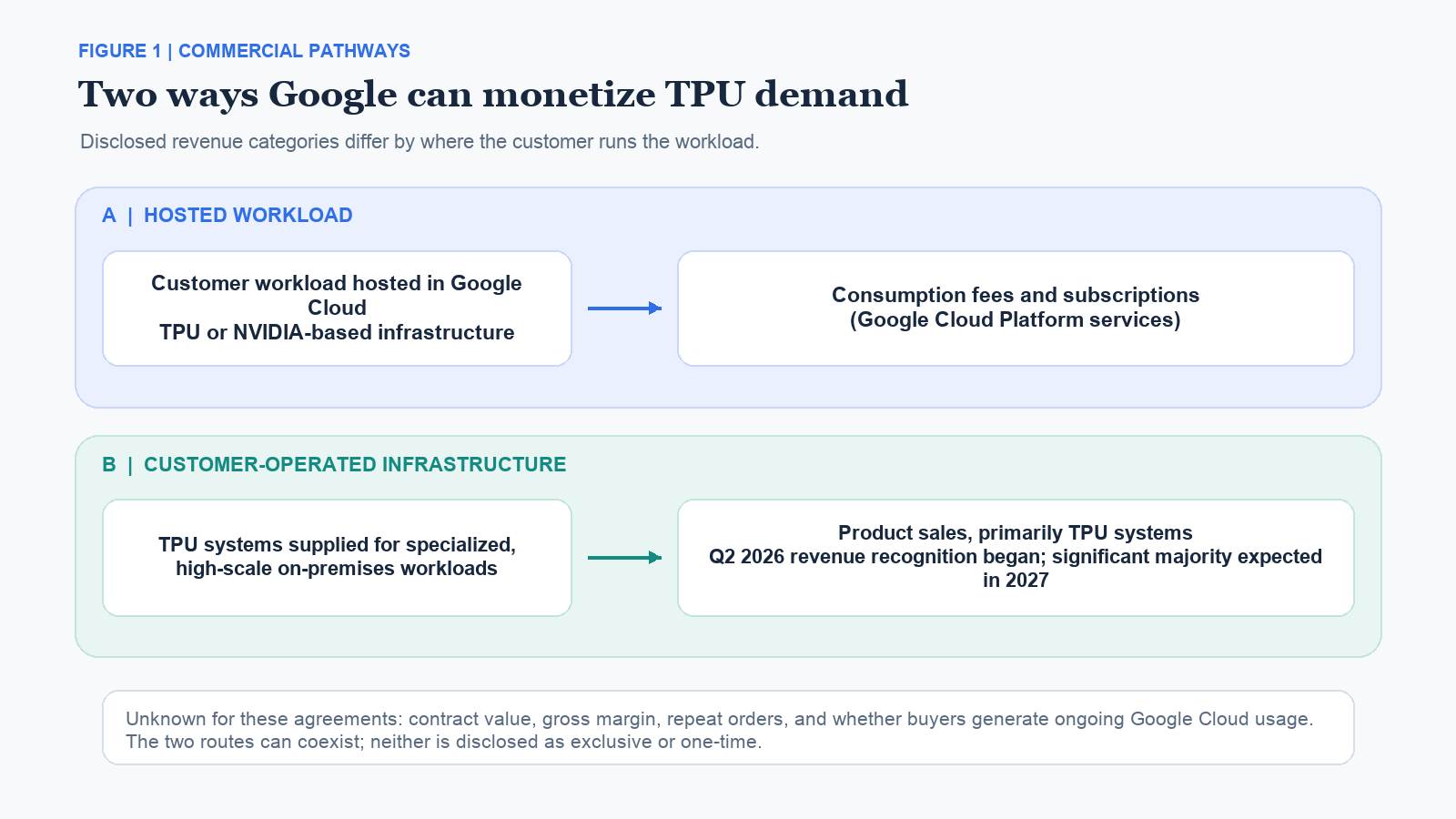
Google’s TPU expansion is opening two routes to AI revenue: hosting workloads in Google Cloud and selling systems for deployment in customer-operated infrastructure. That broadens the commercial opportunity. It also means that a larger hardware footprint can lead to different kinds of revenue, with different timing and customer relationships. The key investment question is how much of each relationship Google retains after a customer chooses its technology. [1]
The events behind that distinction are unusually revealing. On April 6, Anthropic announced a multi-gigawatt expansion of Google and Broadcom TPU capacity, expected to come online starting in 2027, while reaffirming Amazon as its primary cloud provider and training partner. On April 22, Google outlined both new TPUs and a future Nvidia-based cloud platform. Alphabet’s second-quarter filing then disclosed that revenue recognition had begun under a limited number of agreements to supply TPU systems to customers with on-premises infrastructure. [1][2][3]
Our view is that Google is gaining more ways to participate in AI demand. The stronger investment case depends on turning that flexibility into durable customer economics. Chip adoption, cloud usage and model distribution are separate decisions; the available evidence shows why investors should examine all three.
A second sales channel changes the meaning of Cloud growth
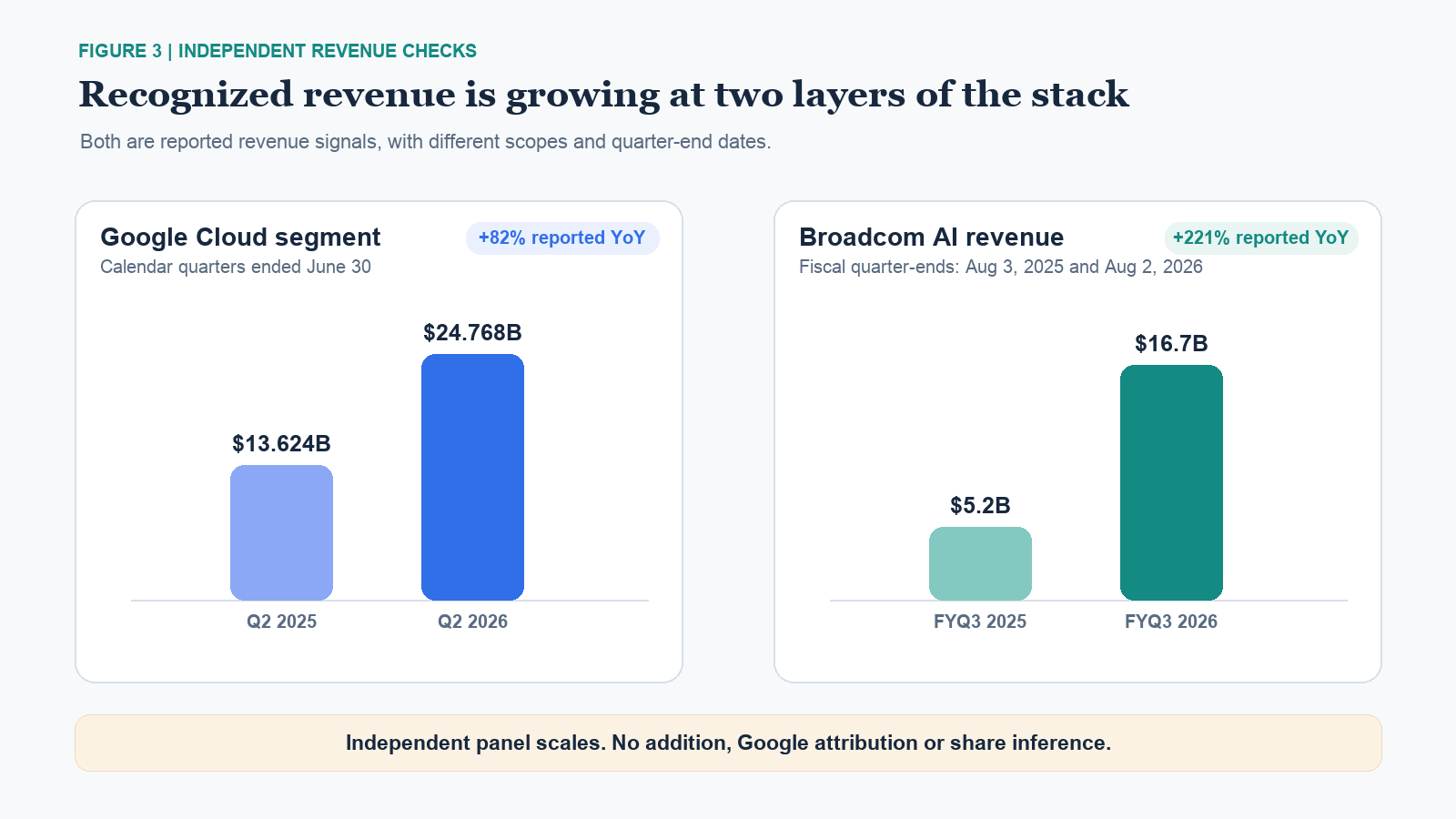
Google Cloud revenue reached $24.768 billion in Q2 2026, up from $13.624 billion a year earlier, or 82% on the company’s reported basis. Alphabet said growth came primarily from Google Cloud Platform infrastructure and platform services. The same segment also includes Workspace subscriptions, product sales and other enterprise services. [1]
The new development is in the product channel. Alphabet says Cloud product revenue comes primarily from TPU systems. It began recognizing revenue from the limited set of on-premises supply agreements in Q2, with the significant majority of revenue under those agreements expected in 2027. The filing does not identify the customers or disclose the amount already recognized. [1]
This creates both an opportunity and a trade-off. Selling systems can reach buyers whose workloads might otherwise remain outside Google’s cloud. But wider TPU distribution does not necessarily pull the hosting relationship into Google Cloud. Google can gain product revenue while more of the customer’s infrastructure operations remain elsewhere. The long-term economics will depend on pricing, repeat orders and any attached services, none of which the filing quantifies for these agreements.
For investors, that changes the quality-of-growth question. A service business expands as customers consume more or buy additional subscriptions. System-supply agreements can have a different recognition pattern, as the disclosed concentration of revenue in 2027 illustrates. If product sales become more material, the composition of Cloud growth will matter more to judgments about its persistence. The disclosure provides a new commercial channel; it does not provide a margin comparison or show that system sales are necessarily one-off transactions.
Two routes to participate in TPU demand
Two labeled channels show Google hosting workloads through Cloud services and selling TPU systems for customer-operated infrastructure; margins and service attachment are not disclosed.
Alphabet Q2 2026 disclosure · revenue channels
Select or focus a chart item to read its scope and limitation.
View exact data: Two routes to participate in TPU demand
| Route | Channel | Disclosed detail |
|---|---|---|
| Host workloads in Google Cloud | Cloud services | Infrastructure and platform services, plus Workspace subscriptions, product sales and other enterprise services in the Cloud segment. |
| Sell TPU systems for customer-operated infrastructure | Product sales | Alphabet says Cloud product revenue comes primarily from TPU systems; revenue recognition began under a limited set of on-premises supply agreements in Q2 2026. |
Anthropic shows how one customer can support several platforms
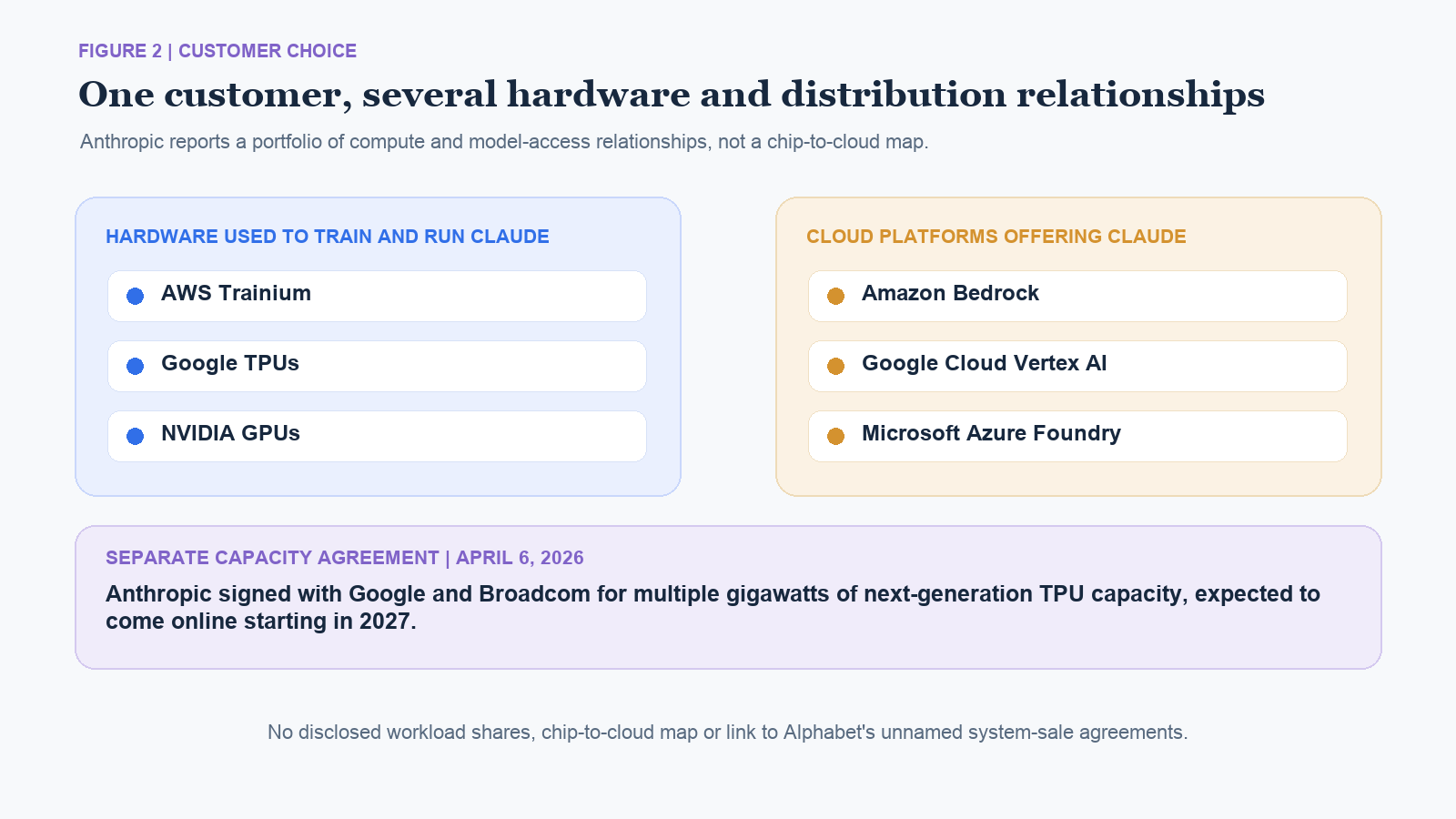
Anthropic provides a useful test of the idea that a TPU win must be an exclusive platform win. Its April announcement combines a large new TPU commitment with an explicit statement that Claude is trained and run across AWS Trainium, Google TPUs and Nvidia GPUs. Amazon remains its primary cloud provider and training partner. Claude is also available through Amazon Bedrock, Google Cloud’s Vertex AI and Microsoft Azure Foundry. [2]
The commercial scale helps explain the appeal of a portfolio approach. In the same announcement, Anthropic said its run-rate revenue had exceeded $30 billion and that more than 1,000 business customers were each spending over $1 million on an annualized basis. These company-reported operating measures give context to its capacity plans: a rapidly expanding customer base makes the timing and reliability of supply consequential. [2]
Maintaining several hardware and cloud relationships is consistent with protecting capacity options and preserving negotiating room. The announcement does not establish which motive dominates, or which architecture is cheapest for a particular workload. It does show that a customer can deepen its TPU relationship while continuing to rely on competing technologies and providers.
That is an important commercial opportunity for Google. It can gain business from a customer without becoming that customer’s primary cloud. For a semiconductor supplier, a design win can add to a customer’s expanding compute portfolio even when competing suppliers remain involved. The size of a new commitment therefore tells us less about a rival’s lost business than an exclusive-contract narrative would suggest.
Model distribution adds another layer. Making Claude available in three clouds gives enterprise buyers several routes to the model. Those distribution channels are not a disclosed map of where Anthropic trains models or which chip serves each request. The distinction matters because the model provider, the cloud selling access and the underlying hardware supplier can capture different portions of the same customer relationship.
Anthropic names multiple hardware and distribution relationships
Anthropic names Trainium, Google TPU and Nvidia GPUs in its hardware portfolio, and Bedrock, Vertex AI and Azure Foundry as distinct model-distribution channels.
Anthropic announcement, April 6, 2026 · company-reported relationships
Select or focus a chart item to read its scope and limitation.
View exact data: Anthropic names multiple hardware and distribution relationships
| Relationship | Disclosed names | Limit |
|---|---|---|
| Hardware portfolio | Trainium · TPU · Nvidia GPUs | Anthropic says Claude is trained and run across AWS Trainium, Google TPUs and Nvidia GPUs; Amazon remains its primary cloud provider and training partner. |
| Model distribution | Bedrock · Vertex AI · Azure Foundry | Separate distribution channels. They do not identify where every model is trained or which chip serves each request. |
| Google/Broadcom capacity | Multi-gigawatt expansion from 2027 | The announcement does not identify Anthropic as an on-premises TPU-system buyer or disclose workload shares. |
Revenue is growing at two layers of the stack
Broadcom supplies an independent financial cross-check. It reported $16.7 billion of AI semiconductor revenue in its fiscal quarter ended August 2, 2026, up 221% year over year. The company associated the strength with custom AI accelerators and networking. The prior-year release reported $5.2 billion under the label “AI revenue”; the current release supplies the 221% year-over-year comparison. [5][6]
Read alongside Google Cloud’s 82% growth, this shows commercial expansion at two different layers of the stack. Cloud infrastructure and platform revenue is growing, while a supplier selling custom accelerators and networking is already recognizing substantial AI semiconductor revenue. The evidence goes beyond announced future capacity, although it does not identify how much of Broadcom’s growth came from Google.
The product scope also matters economically. Broadcom’s AI category contains networking as well as custom accelerators. Delivering useful compute requires connected systems, so value can accrue beyond the processor carrying the most visible brand. Investors evaluating custom-silicon exposure should examine the content supplied and the strength of the customer relationship, rather than assigning the entire opportunity to a single chip label.
The two revenue series measure different transactions, scopes and fiscal periods. They support evidence of current commercialization across the stack; they cannot be added into a market total or used to calculate TPU share. Nor do they establish Nvidia displacement. Anthropic’s hardware portfolio is direct evidence that coexistence is possible; the broader rate of substitution remains undisclosed.
The investment implication is more specific than a general call that AI spending is strong. Custom silicon can create an additional route for suppliers to earn revenue, but the retained economics depend on accelerator content, networking, contract terms and execution. A named partnership establishes a commercial relationship. It does not reveal the supplier’s revenue allocation or profitability on that relationship.
Recognized revenue grew at two distinct layers of the stack
Two separate panels show Google Cloud revenue rising from $13.624 billion in Q2 2025 to $24.768 billion in Q2 2026, and Broadcom AI-category revenue rising from $5.2 billion in FYQ3 2025 to $16.7 billion in FYQ3 2026; the periods and definitions differ.
Google Cloud segment
USD billions · Calendar quarters ended June 30; Alphabet reports +82% year over year. The segment includes infrastructure/platform, Workspace, product sales and other enterprise services.
Broadcom AI category
USD billions · FYQ3 2025 release calls this “AI revenue”; FYQ3 2026 release calls it “AI semiconductor revenue” and reports +221% year over year. Category includes custom accelerators and networking.
Select or focus a chart item to read its scope and limitation.
View exact data: Recognized revenue grew at two distinct layers of the stack
| Series and period | USD billions | Scope and notes |
|---|---|---|
| Google Cloud · Q2 2025 | $13.624B | Calendar quarter ended June 30, 2025. |
| Google Cloud · Q2 2026 | $24.768B | Calendar quarter ended June 30, 2026; reported growth +82% year over year. |
| Broadcom · FYQ3 2025 | $5.2B | Quarter ended August 3, 2025; release label: “AI revenue”. |
| Broadcom · FYQ3 2026 | $16.7B | Quarter ended August 2, 2026; release label: “AI semiconductor revenue”; reported growth +221% year over year. |
Software and delivery determine which route scales
Google’s product roadmap helps explain how it might reach different workloads. Its April announcement introduced TPU 8t and TPU 8i, alongside plans for the Nvidia Vera Rubin-based A5X platform. It also described TorchTPU, intended to improve the PyTorch experience on TPUs, as a preview for selected customers. [3]
There is a commercial reason for Google to support both paths. A customer bringing an Nvidia-oriented workload to Google Cloud can still create a services relationship for Google. Better PyTorch support could also make TPU evaluation and migration more practical. On this reading, the priority is to make Google a viable home for more workloads, while keeping its own hardware available to customers who prefer a different deployment model. That is a broader opportunity than accelerator sales alone, but it also exposes Google to buyers with more architectural choice and negotiating room. [3]
That flexibility creates distinct opportunities. A cloud customer may generate service revenue using Nvidia hardware. A buyer deploying Google’s TPU systems in its own facility may generate product revenue while retaining more control over the hosting environment. These routes can coexist, but they need not produce the same duration of revenue or the same service attachment. Google has not disclosed enough contract economics to rank them by profitability.
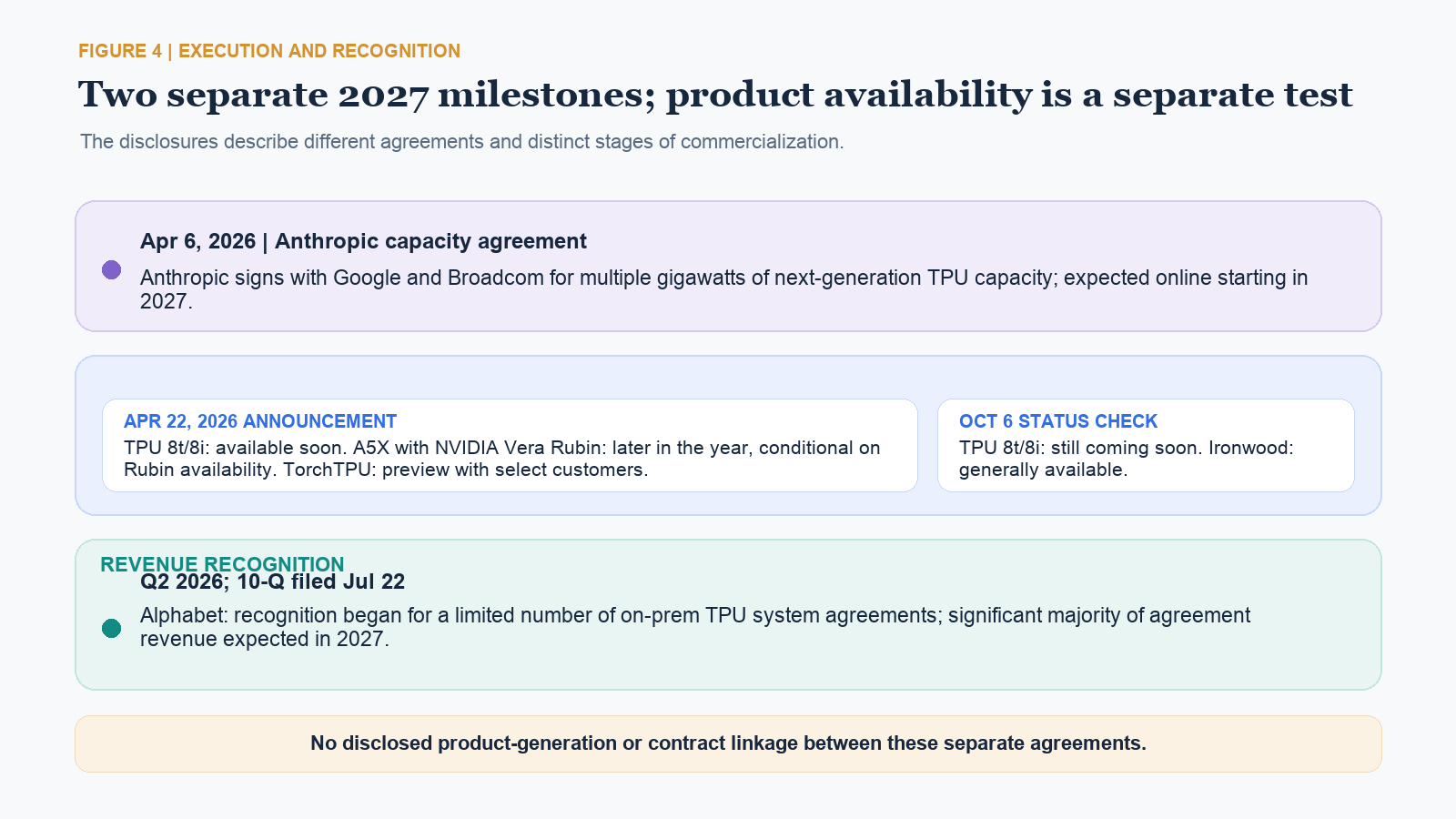
The calendar is the next test. On the Google TPU product page checked on October 6, TPU 8t and 8i were still marked as coming soon; Ironwood was generally available. The April A5X announcement was conditional on Vera Rubin becoming available later in the year, and TorchTPU’s described status was a selected-customer preview. Those announcements establish a product direction. They do not, by themselves, demonstrate production adoption or customer cost savings. [3][4]
There are also two separate 2027 milestones. Anthropic expects its announced Google/Broadcom capacity expansion to begin coming online then. Alphabet expects the significant majority of revenue from its limited on-premises TPU agreements to be recognized in 2027. Public disclosures do not establish that Anthropic belongs to that set of system-sale customers. One is a named capacity arrangement; the other is a revenue-recognition disclosure for unnamed agreements. [1][2]
The two milestones expose different execution questions: whether capacity becomes usable on the promised schedule, and whether the system agreements translate into the revenue recognition Alphabet anticipates. Treating them separately makes the investment case more testable.
Product readiness and two separate 2027 milestones
Timeline separates Anthropic's expected 2027 capacity expansion, Google's TPU and Nvidia-based roadmap, Alphabet's on-premises TPU-system revenue milestone, and the October 6 product-status check.
April–October 2026 disclosures and expected milestones · dated announcements and status checks
Select or focus a chart item to read its scope and limitation.
View exact data: Product readiness and two separate 2027 milestones
| Date or period | Milestone | Evidence and limit |
|---|---|---|
| April 6, 2026 | Anthropic capacity expansion announced | Google/Broadcom TPU capacity is expected to come online starting in 2027; Anthropic also reaffirms Amazon as primary cloud provider and training partner. |
| April 22, 2026 | Google outlines TPU and Nvidia-based cloud roadmap | TPU 8t/8i, a future Nvidia Vera Rubin-based A5X platform, and TorchTPU preview for selected customers are announced. |
| Q2 2026; majority expected in 2027 | On-premises TPU-system revenue recognition begins | Alphabet says recognition began under a limited number of agreements; most revenue under those agreements is expected in 2027. Customers and amounts are undisclosed. |
| October 6, 2026 | TPU product-page status check | TPU 8t and 8i were marked coming soon; Ironwood was generally available. This is a dated status check, not evidence of later adoption. |
What would strengthen the case?
The evidence supports a constructive view of Google’s commercial reach. Its TPU strategy can serve cloud customers and customers operating their own infrastructure, while its broader hardware offering gives buyers additional ways to engage. Anthropic demonstrates how a large customer can expand that opportunity without giving Google an exclusive relationship.
The next evidence that matters is more specific: production customer use after product availability, revenue recognition under the disclosed system agreements, repeat demand beyond initial deployments, and information about any continuing services attached to those sales. These would help establish whether a larger TPU footprint is producing durable customer value for Google.
The case would weaken if availability or capacity milestones slip, anticipated system revenue fails to materialize, or customer usage and repeat demand lag the initial commitments. Broadcom’s AI semiconductor revenue offers a separate check on supplier commercialization, with its own product and customer mix.
Google has created more ways to participate in the AI buildout. The investment task is now to distinguish where it wins the hardware order, where it hosts the workload, and where it retains the ongoing customer economics. That is a more revealing lens on its TPU expansion than Cloud growth alone.
Source and method note
Alphabet Cloud and Broadcom AI semiconductor figures are drawn from the original company disclosures cited below. Their revenue scopes and quarter-end dates differ; no supplier share, Google attribution or TPU/GPU workload mix is calculated. Product status is dated to the source or the October 6 check indicated above. Figures distinguish disclosed facts from editorial interpretation.
Public sources
[1] Alphabet Q2 2026 Form 10-Q, filed July 22, 2026, quarter ended June 30. https://www.sec.gov/Archives/edgar/data/1652044/000165204426000071/goog-20260630.htm
[2] Anthropic, April 6, 2026, Google/Broadcom compute partnership. https://www.anthropic.com/news/google-broadcom-partnership-compute
[3] Google Cloud, April 22, 2026, AI infrastructure at Next ’26. https://cloud.google.com/blog/products/compute/ai-infrastructure-at-next26
[4] Google Cloud TPU product page, checked October 6, 2026. https://cloud.google.com/tpu
[5] Broadcom Q3 FY2026 earnings release, September 2, 2026; fiscal quarter ended August 2. https://www.sec.gov/Archives/edgar/data/1730168/000173016826000076/avgo-08022026x8kxex99.htm
[6] Broadcom Q3 FY2025 earnings release, September 4, 2025; fiscal quarter ended August 3. https://www.sec.gov/Archives/edgar/data/1730168/000173016825000094/avgo-08032025x8kxex99.htm