
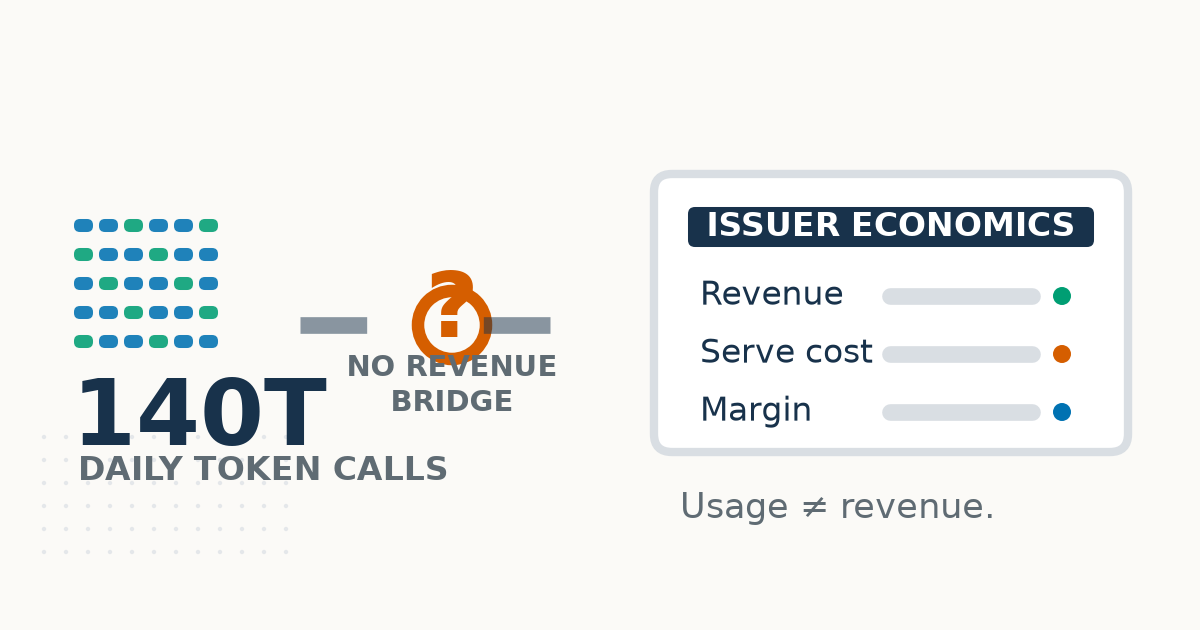
China’s reported AI usage is rising at remarkable speed. By the end of March 2026, daily token calls had exceeded 140 trillion, according to the National Data Administration. For investors, that number establishes one useful point: measured inference activity has expanded rapidly. It does not establish how much customers paid, what it cost providers to serve those calls, or whether listed model companies are approaching profitability. [1]
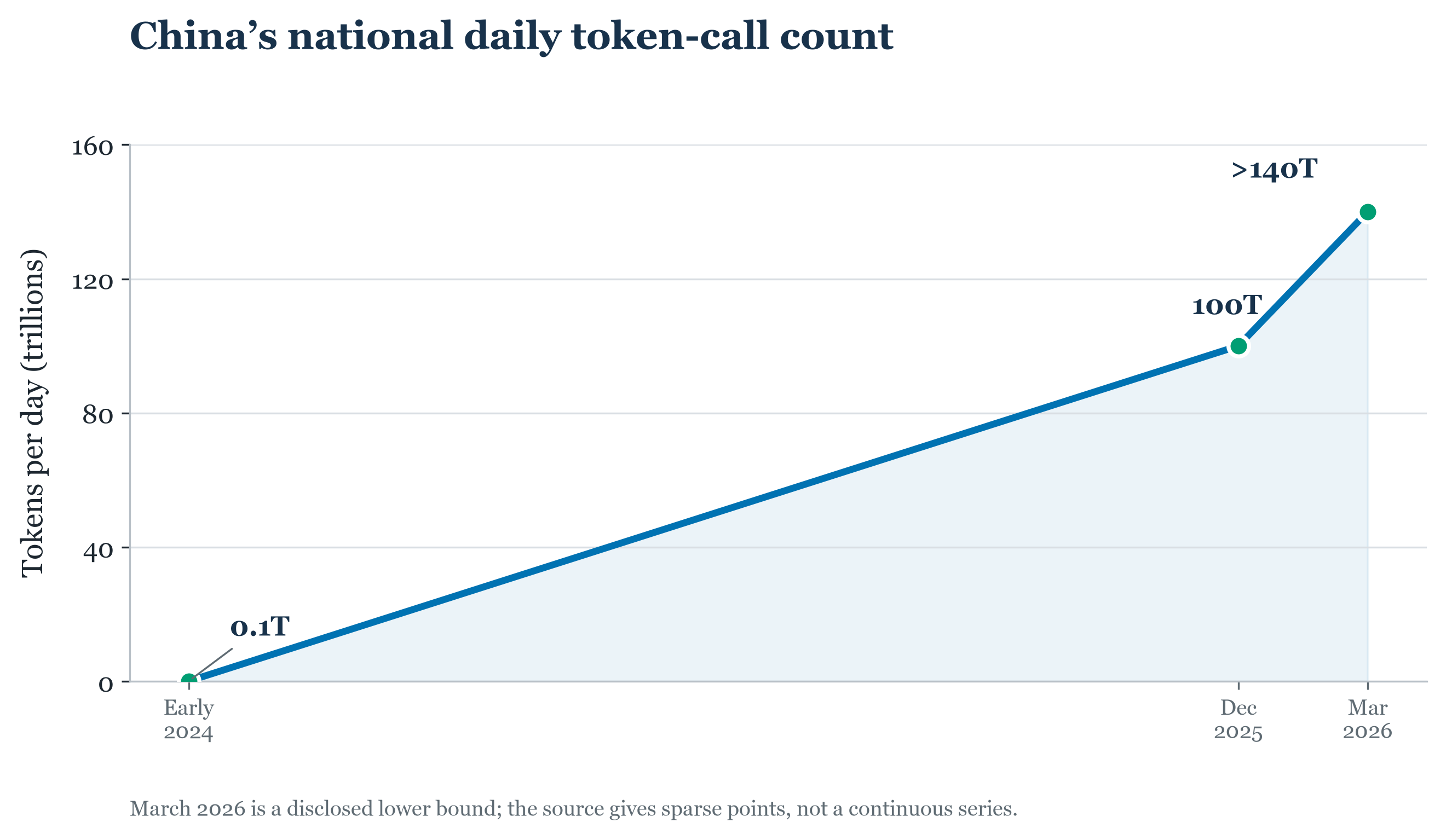
The distinction matters because a token count is a unit of activity, not a unit of economic value. A free consumer request, a discounted enterprise contract, and a full-price API call can all add to volume while producing very different revenue and margins. The reviewed public sources show no national revenue conversion ratio. The cited announcement gives only a sparse series and no calculation methodology: 0.1 trillion daily calls in early 2024, 100 trillion at the end of 2025, and more than 140 trillion by the end of March 2026. The latest figure is a lower bound, not an exact 140 trillion. [1]
Figure 01
A time-scaled chart shows reported national daily token calls at 0.1 trillion early in 2024 and 100 trillion at end-2025, with the March 2026 point labeled greater than 140 trillion; the last point is a lower bound.
Even a perfectly observed volume series would need a pricing framework before it could support a revenue estimate. An August article from the National Development and Reform Commission’s research center identifies token counting and price standardization as policy issues. It says model tokenization is not externally transparent, that the same semantic content can yield token counts that differ by multiples under different models’ tokenization rules, and that equal volumes can carry very different economic value. It also notes that quantity-based pricing may fail to reflect quality. Those are reasons to be careful when interpreting the unit; the article is not an audit of the national daily count. [2]
A separate official series counts services filed and applications or functions registered in China’s AI system, but it answers another question. The Cyberspace Administration of China said 124 additional generative AI services were filed and 133 additional applications or functions were registered during July and August 2026. By August 31, the cumulative totals were 1,112 filed services and 731 registered applications or functions. These are two distinct administrative counts. Neither is a count of paying users, token calls, or revenue. They indicate supply and regulatory activity, not monetization. [3]
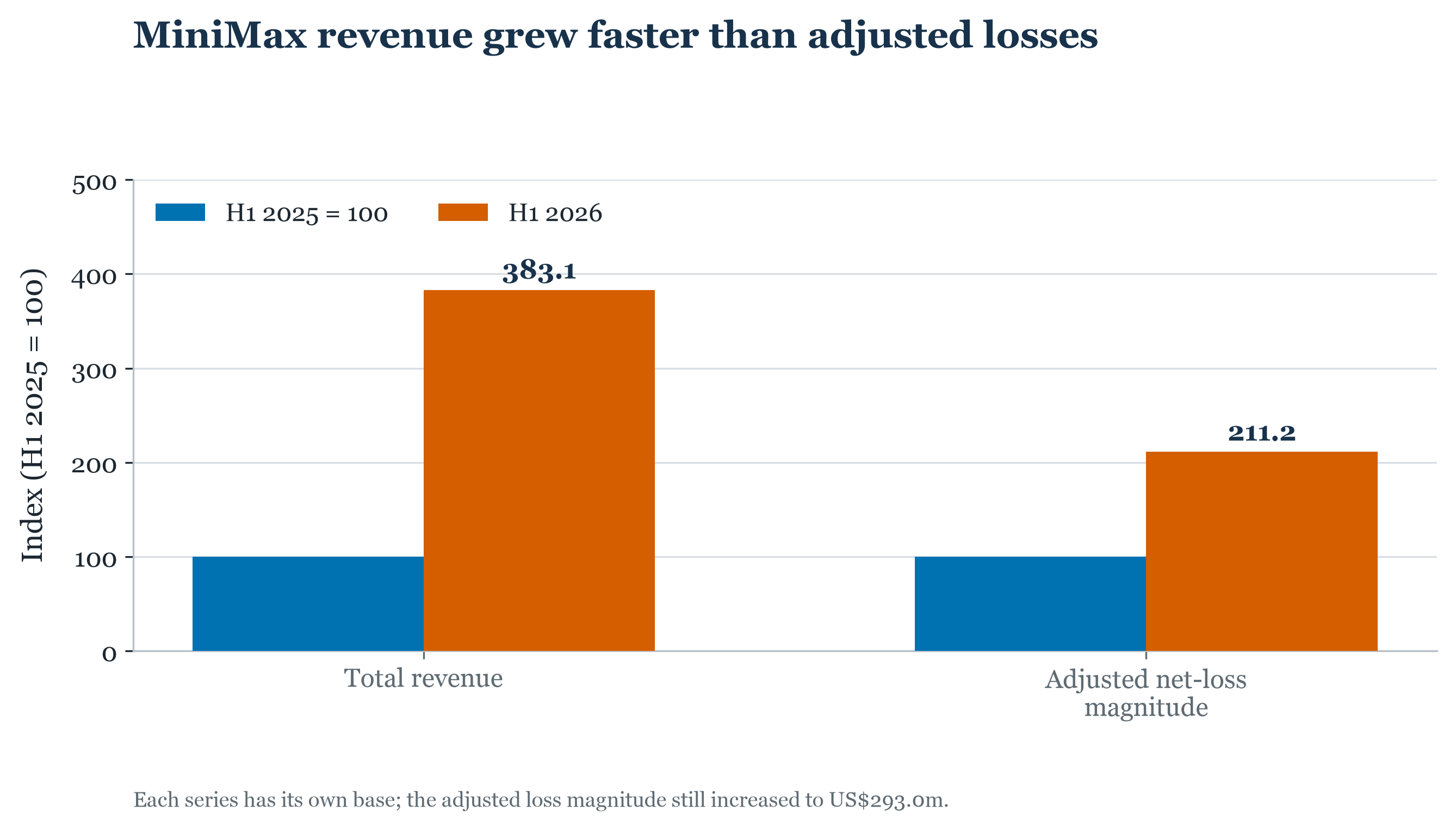
Company disclosures provide a closer view of recognized revenue, though they cannot convert the national tally into earnings. MiniMax reported US$116.573 million of revenue for the first half of 2026, up from US$30.429 million a year earlier. Its Open Platform and other AI-based enterprise services contributed US$73.9 million, or 63.4% of total revenue. That mix makes the company a useful example of commercial demand for model services. Yet its gross margin was 17.9%, compared with 12.1% a year earlier, while its adjusted net loss widened to US$293.031 million from US$138.735 million. Revenue grew faster than the magnitude of the adjusted loss, but the loss still grew. MiniMax defines adjusted net loss as a non-IFRS measure that adds back share-based payments, fair-value losses on financial liabilities, and listing expenses. [4]
Figure 02
Grouped bars show MiniMax H1 2025 and H1 2026 values independently indexed to 100 for total revenue and adjusted net loss magnitude; 2026 indices are 383.1 and 211.2.
Zhipu supplies the sharper accounting contradiction. In its first-half 2026 interim report, revenue reached RMB 953.892 million, versus RMB 190.877 million a year earlier. Zhipu reported RMB 825.176 million as “open platform and API” revenue, or 86.5% of the total. Its reported loss for the period fell to RMB 2,071.992 million from RMB 2,357.852 million. But its adjusted net loss rose to RMB 1,964.138 million from RMB 1,751.974 million, while gross profit margin fell to 26.4% from 50.0%. The report says losses from changes in the carrying amounts of financial instruments issued to investors fell to RMB 22.1 million from RMB 429.3 million; the instruments were derecognized upon the January 2026 listing, so the 2026 charge covered only the pre-listing period. Its non-IFRS adjusted-loss measure adds back those changes, share-based compensation, and listing expenses. The lower reported loss therefore should not be read, by itself, as proof of better underlying operations. [5]
Together, the two issuers show why “more tokens” is too short an investment thesis. MiniMax demonstrates rapid revenue growth alongside an expanding adjusted loss. Zhipu demonstrates rapid total revenue growth, with its combined “open platform and API” category accounting for 86.5% of H1 2026 revenue, alongside a falling gross margin and an adjusted loss moving in the opposite direction from its reported loss. Both companies have evidence of monetization in their own financial statements. Neither disclosure attributes its revenue to a measured share of the national token count, and their results cannot be extrapolated to China’s entire AI economy. They are a small, selected listed sample with different product mixes, prices, costs, and accounting effects. [4][5]
The investment question is whether paid demand can grow at attractive incremental margins. To answer it, investors need issuer-level disclosures that connect usage to realized pricing, revenue, cost of sales, and gross profit. A rising national count may strengthen the case that inference is becoming widespread. It cannot tell investors who captures the spending or how much of it survives the cost of serving requests.
AI Economy Radar helps investors put such headlines in context by tracking demand, adoption, infrastructure and funding signals over time and cross-checking independent evidence to support portfolio decisions. Explore the dated September 6, 2026 tracker preview to see how the service organizes those signals.
Watchlist from October 2026
At the next official token-count release, look for the measurement period, coverage, and calculation method, alongside any updated daily figure. The next release date was not announced in the public sources reviewed as of October 10, 2026. At the next CAC update, track filed services and registered applications or functions as separate supply measures. In the issuers’ next interim or annual results, check paid Open Platform and API revenue, disclosed token pricing, gross margin and cost of sales, and the bridge between reported and adjusted losses. Those disclosures will do more to test the earnings thesis than another large national volume milestone. [1][3][4][5]
Sources
[1] National Data Administration, “What Does 140 Trillion Daily Tokens Mean?”, April 4, 2026.
[2] National Development and Reform Commission, Xi Jinping Economic Thought Research Center, “The Token Economy Is Emerging: Several Hurdles for Healthy Development”, August 14, 2026.
[3] Cyberspace Administration of China, Notice on Filed Generative AI Services, July–August 2026, September 14, 2026.
[4] MiniMax, First-Half 2026 Financial Results, August 26, 2026.
[5] Z.AI (Zhipu AI), 2026 Interim Results Announcement, August 31, 2026.