
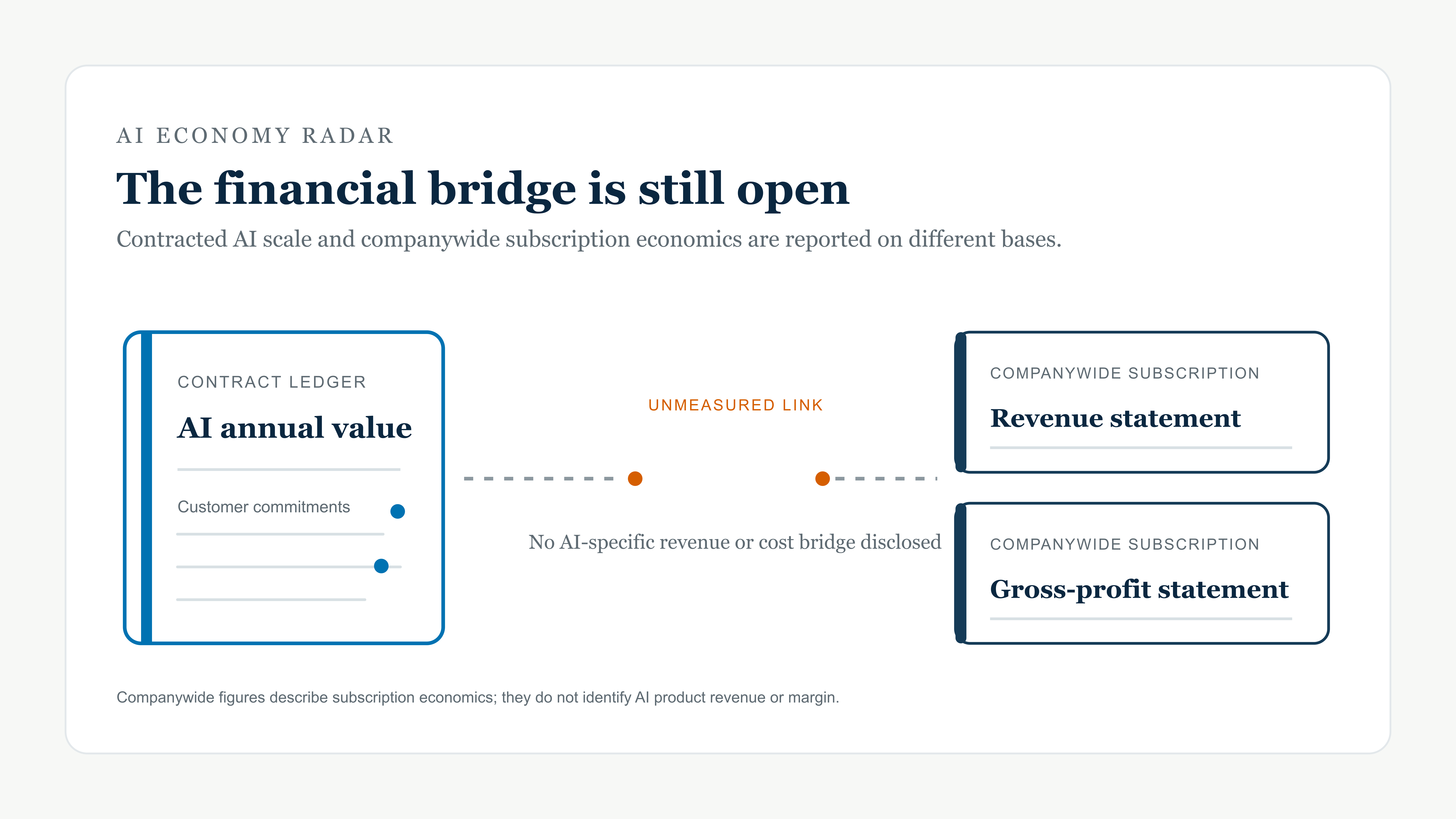
Hero. A contract ledger beside companywide subscription results illustrates the missing AI-specific revenue-and-cost bridge.
In its second quarter of 2026, ServiceNow said AI annual contract value, or ACV, surpassed $1 billion. Companywide subscription revenue rose to $3.877 billion from $3.113 billion a year earlier. The headline establishes meaningful contracted scale. It does not show how much AI revenue was recognized during the quarter or how profitable those contracts are. That distinction is central to judging the quality of ServiceNow’s growth. ServiceNow Q2 2026 results
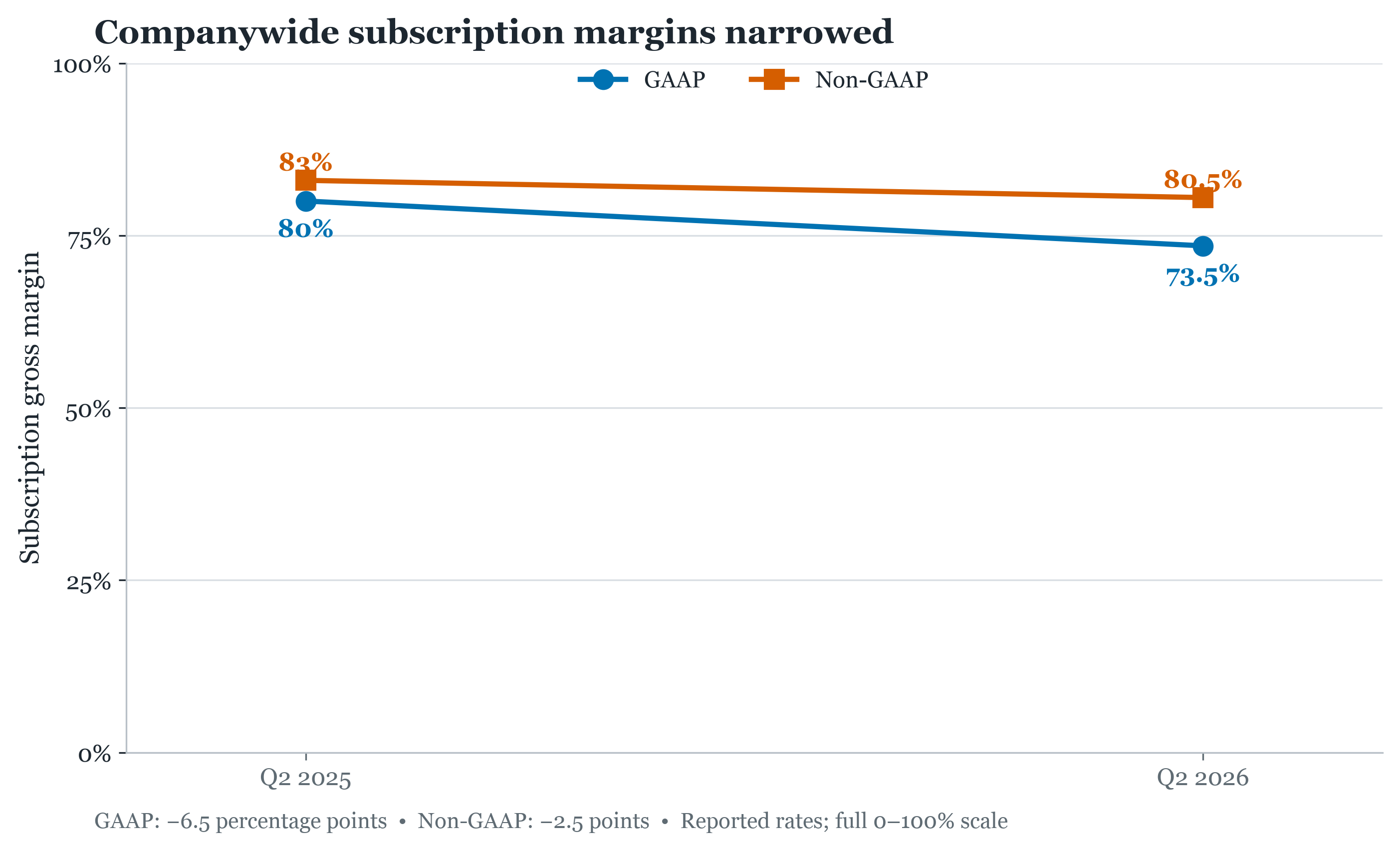
The economic tension sits in the same results. The companywide GAAP subscription gross-margin rate fell from 80% in Q2 2025 to 73.5% in Q2 2026. The corresponding non-GAAP rate fell from 83% to 80.5%. The AI contract milestone arrived in a quarter when ServiceNow retained a smaller share of each subscription-revenue dollar after reported subscription costs. The results give investors a reason to ask for an AI revenue-and-cost bridge; they do not attribute the companywide margin decline to AI. ServiceNow Q2 2026 results
Companywide subscription margins narrowed
Two pairs of companywide subscription gross-margin rates, showing GAAP at 80% and 73.5% and non-GAAP at 83% and 80.5% for Q2 2025 and Q2 2026.
More profit dollars, less margin per dollar
The lower margin rate did not mean lower subscription gross-profit dollars. ServiceNow reported $2.847 billion of GAAP subscription gross profit in Q2 2026, up from $2.488 billion in Q2 2025. Revenue growth more than offset the lower rate in absolute dollars. This is a useful counterpoint to a reading that treats margin compression as a fall in gross profit. It is also why both measures belong in an assessment: the business generated more gross profit overall while each revenue dollar carried a thinner companywide gross margin. These are issuer-reported quarterly figures for the subscription business, not inferred AI product economics. ServiceNow Q2 2026 results
The GAAP rate declined 6.5 percentage points year over year; the non-GAAP rate declined 2.5 points. ServiceNow’s reconciliation shows that the acquired-intangible-amortization addback grew from 0.5% to 4.5% of subscription revenue over those quarters, while the share-based-compensation addback was 2.5% in both. More amortization helps explain the wider GAAP move. The adjusted margin still fell, so the question cannot end with acquisition accounting. ServiceNow Q2 2026 results
The amortization charge is noncash in the quarter, but it reflects the accounting cost of assets acquired to build the business. Excluding it can help isolate operating performance; watching only the adjusted rate can obscure the scale of acquisition-related charges. Together, the two rates show how much of the change persists after the listed adjustments. Neither provides a standalone measure of AI contract profitability.
ServiceNow’s 10-Q says its Q2 2026 companywide subscription costs increased primarily with headcount and support for subscription growth; it lists higher personnel, data-center support, third-party cloud commitments, and acquired-intangible amortization among the contributors. Separately, ServiceNow expects its full-year 2026 subscription gross-margin percentage to decline from 2025, primarily due to cloud-services usage and acquired-intangible amortization. Cloud-service costs matter to the durability of margins because they are part of delivering subscriptions as customers use the platform. The filing does not allocate those costs to AI offerings. Investors can identify a cost driver at the company level while leaving AI’s contribution to that driver open. ServiceNow Q2 2026 Form 10-Q
What does the AI threshold include?
ServiceNow reported that AI ACV surpassed, rather than equaled, $1 billion. The release supplies a threshold, not a precise endpoint. It does not publish a calculation definition, a breakdown by offering, or an acquired-versus-organic split for that figure. The number supports a conclusion about contracted AI scale; it leaves the composition of that scale unsettled. ServiceNow Q2 2026 results
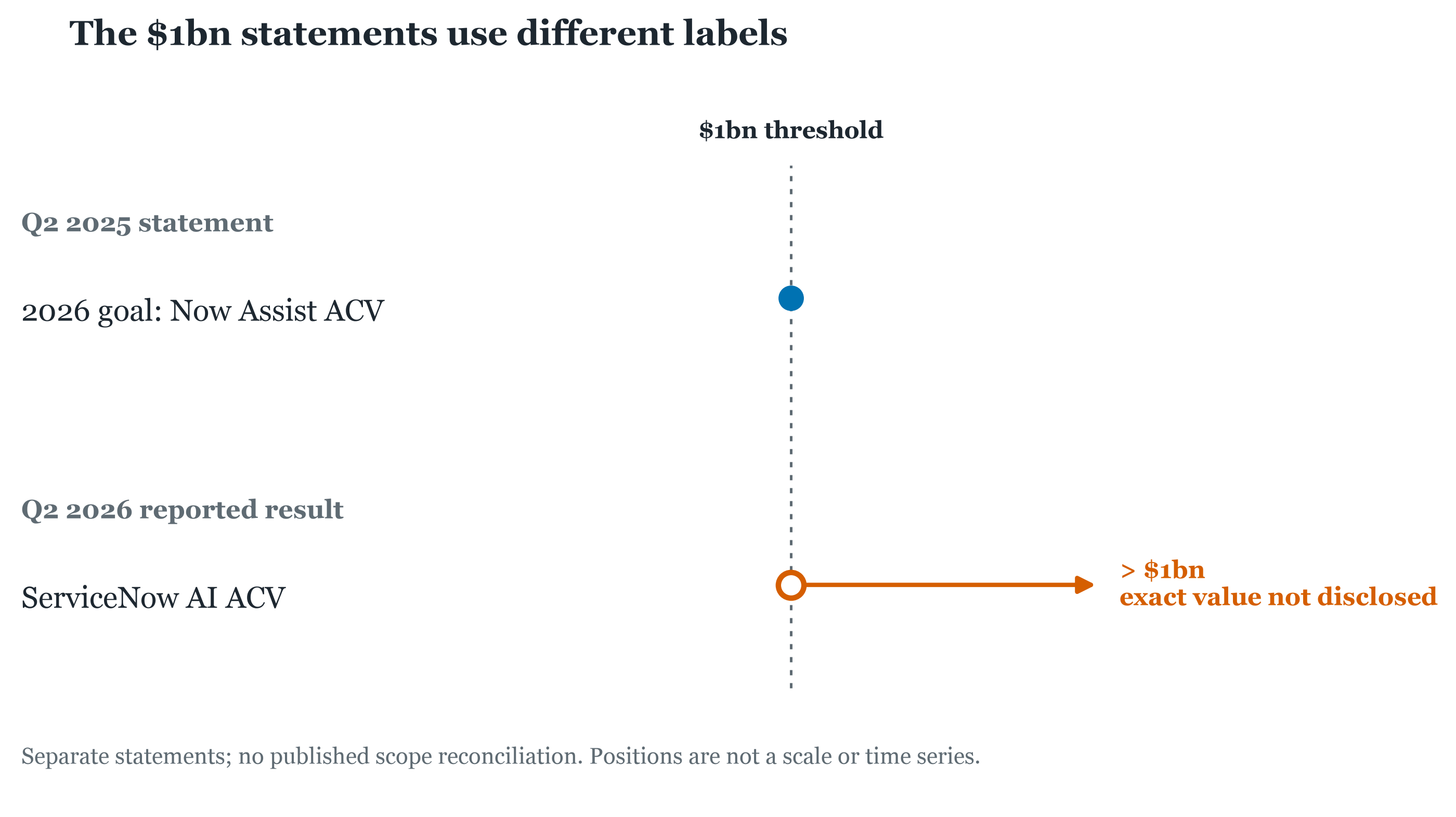
A comparison with last year illustrates the importance of scope. In Q2 2025, ServiceNow described a 2026 goal of reaching $1 billion in ACV from Now Assist. The Q2 2026 milestone is labeled ServiceNow AI ACV. The company has not provided a reconciliation between those labels. That gap does not prove a definition changed. It means investors cannot calculate like-for-like growth from the two statements alone. ServiceNow Q2 2025 results · ServiceNow Q2 2026 results
Two AI ACV statements use different labels
A 2025 Now Assist goal of one billion dollars in 2026 ACV and a separate Q2 2026 ServiceNow AI milestone above one billion dollars, with no connecting growth line.
The scope question has a concrete investment consequence. An expanding AI contract base could reflect more customers, larger commitments from existing customers, a wider set of products counted as AI, or some combination. Those paths have different implications for future revenue. Additional customer adoption may create a broader renewal base. Larger commitments can raise the value of each relationship. A wider metric perimeter can lift the reported total without showing that comparable products gained the same amount. ServiceNow has not disclosed the components needed to separate these effects.
ServiceNow completed its Moveworks acquisition on December 15, 2025. That event makes the acquired-versus-organic split worth examining, but it does not establish whether Moveworks contributed to the reported AI ACV milestone or by how much. Assigning it a contribution would manufacture a bridge the company has not supplied. ServiceNow FY2025 results · ServiceNow Q2 2026 results
The same uncertainty applies to pricing and mix. A contract can gain value because a customer buys additional capability, expands its deployment, or negotiates a different package. If AI increases the total value of a platform agreement, an investor still needs to know whether it brought incremental price, displaced spending on another component, or changed the service commitment. The $1 billion threshold does not resolve those alternatives. Their distinction matters because each produces a different path from signed contracts to durable profit.
The route from a contract to the income statement
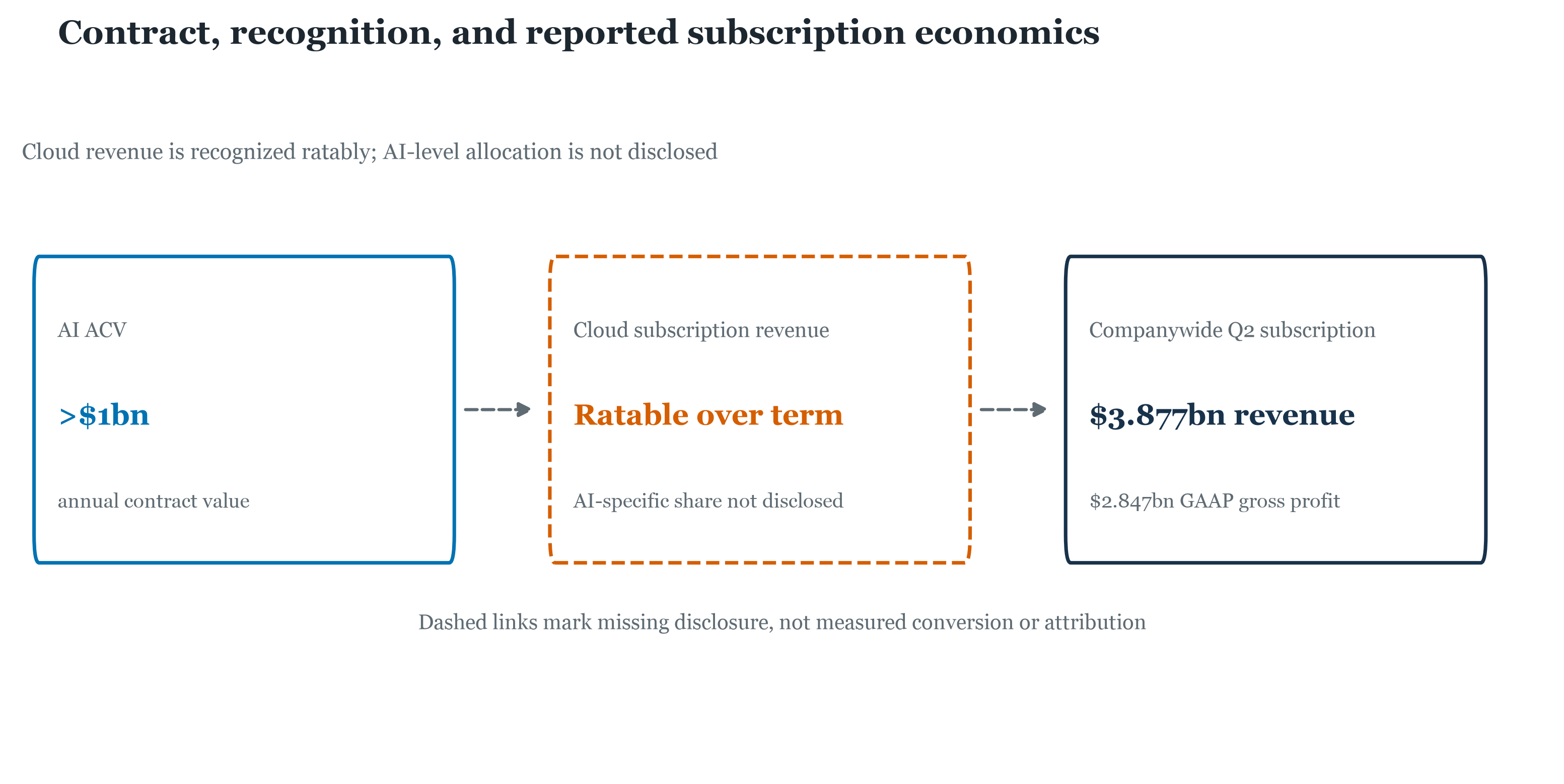
ACV and recognized revenue have different clocks. ServiceNow’s 10-Q says cloud-subscription revenue is recognized ratably over the subscription term. The filing also describes different recognition for self-hosted subscriptions, a substantial portion of which is recognized upon delivery. An annual contract-value milestone therefore cannot be laid directly beside one quarter’s subscription revenue as if both were earned over the same interval. ServiceNow Q2 2026 Form 10-Q
Contract value and subscription economics
Conceptual flow from a cloud-subscription contract through ratable revenue recognition to companywide subscription gross profit, with AI-specific amounts marked undisclosed.
Timing also complicates the companywide growth figure. ServiceNow said Q2 subscription-revenue outperformance reflected net new ACV and on-premise mix, and that some U.S. federal revenue shifted from Q3 into Q2. A quarter can therefore look stronger partly because of when revenue lands. The disclosed 24.5% year-over-year subscription-revenue growth is real, but the release does not divide it into AI and other offerings. Federal timing should be watched when comparing Q2 and Q3; it supplies no estimate of AI’s share. ServiceNow Q2 2026 results
The recognition bridge becomes more informative as contracts renew. If an AI offering retains customers and supports higher prices after actual usage is established, its initial ACV may develop into durable revenue. If contract value is bundled into a broader relationship without separate renewal evidence, the milestone still demonstrates contracting but reveals less about stand-alone demand. These are conditional economic paths, not disclosed outcomes for ServiceNow’s AI products.
Costs could follow a different path from the contract price. In any fixed-price subscription, rising usage can increase variable computing expense before a renewal or repricing opportunity. If that occurred in an AI offering, the gross-margin effect would depend on usage, contract terms, efficiency gains, and the customer’s willingness to pay at renewal. ServiceNow has not disclosed an AI-specific price or cost schedule that would establish this pattern. The mechanism explains why a product-level revenue-and-cost bridge would sharpen the investment case: contract volume alone cannot show whether incremental use earns an attractive return.
A market signal with a different denominator
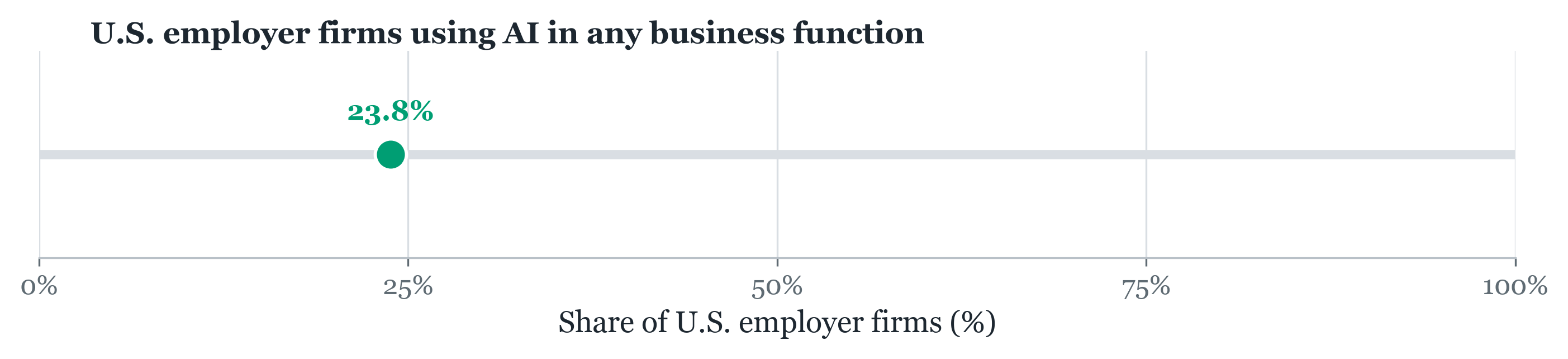
The Census Bureau’s Business Trends and Outlook Survey found that 23.8% of U.S. employer firms, across all firm sizes, reported using AI in any business function in the wave with collection ending September 20, 2026. This national firm-use reading is market context, not a count of ServiceNow customers or a denominator for its AI ACV. U.S. Census Bureau, BTOS downloads · National data workbook
AI use across U.S. employer firms
A single 23.8 percent survey reading for U.S. employer firms reporting AI use in any business function, with the collection ending September 20, 2026.
The next results should test both scale and conversion
As of October 8, 2026, ServiceNow’s latest official quarterly release for this assessment is Q2 2026. At the next Q3 FY2026 results, investors can compare companywide subscription revenue with the company’s Q2-issued guidance of $3.975 billion to $3.980 billion, or roughly 20.5% year-over-year growth. Its guidance for companywide current remaining performance obligation growth was 19.5%. Neither is an AI-specific series. The Q3 comparison is useful partly because of the federal revenue that shifted into Q2. ServiceNow Q2 2026 results and guidance
The more discriminating test is whether the next release repeats the AI ACV metric with a stable definition. A larger figure accompanied by a clear product scope, recognized-revenue evidence, and renewal detail would strengthen the link between contract scale and lasting demand. If the company again reports only a headline threshold, the contracted base may keep growing while its contribution to revenue remains hard to isolate. Watch the GAAP and non-GAAP subscription gross-margin rates beside it: an improvement in both would support better companywide economics, while a further adjusted-margin decline would make the delivery-cost question more pressing. Neither outcome alone proves an AI-specific margin.
At the 2026 year-end results, the earlier Now Assist goal and the later ServiceNow AI milestone deserve a scope reconciliation. The most useful disclosure would connect a consistent AI ACV series to recognized revenue and explain whether acquisitions, broader product coverage, and renewals changed the measure. Until then, the investor conclusion is deliberately narrow: ServiceNow has crossed a substantial AI contracting threshold and grown subscription gross-profit dollars, while companywide margin rates have narrowed. The missing bridge determines how much of that AI contract scale becomes durable, profitable revenue.
Follow AI Economy Radar for evidence-led analysis of how AI adoption appears in company results and which financial links still need to be measured.
Sources
- ServiceNow, Q2 2026 financial results, July 22, 2026.
- ServiceNow, Q2 2026 Form 10-Q.
- ServiceNow, Q2 2025 financial results.
- ServiceNow, FY2025 financial results.
- U.S. Census Bureau, BTOS data downloads and National workbook.
Appendix
ACV is a contracted annual-value measure; it is not quarterly recognized revenue. Subscription gross margin divides subscription gross profit by subscription revenue. The 6.5- and 2.5-percentage-point changes above compare Q2 2025 with Q2 2026 using the company’s reported margin rates. Those rates follow the issuer’s rounded reconciliation and should not be treated as exact ratios for deriving gross-profit dollars; the gross-profit dollars cited above are issuer-reported. The Census percentage uses U.S. employer firms across all sizes as its denominator.