
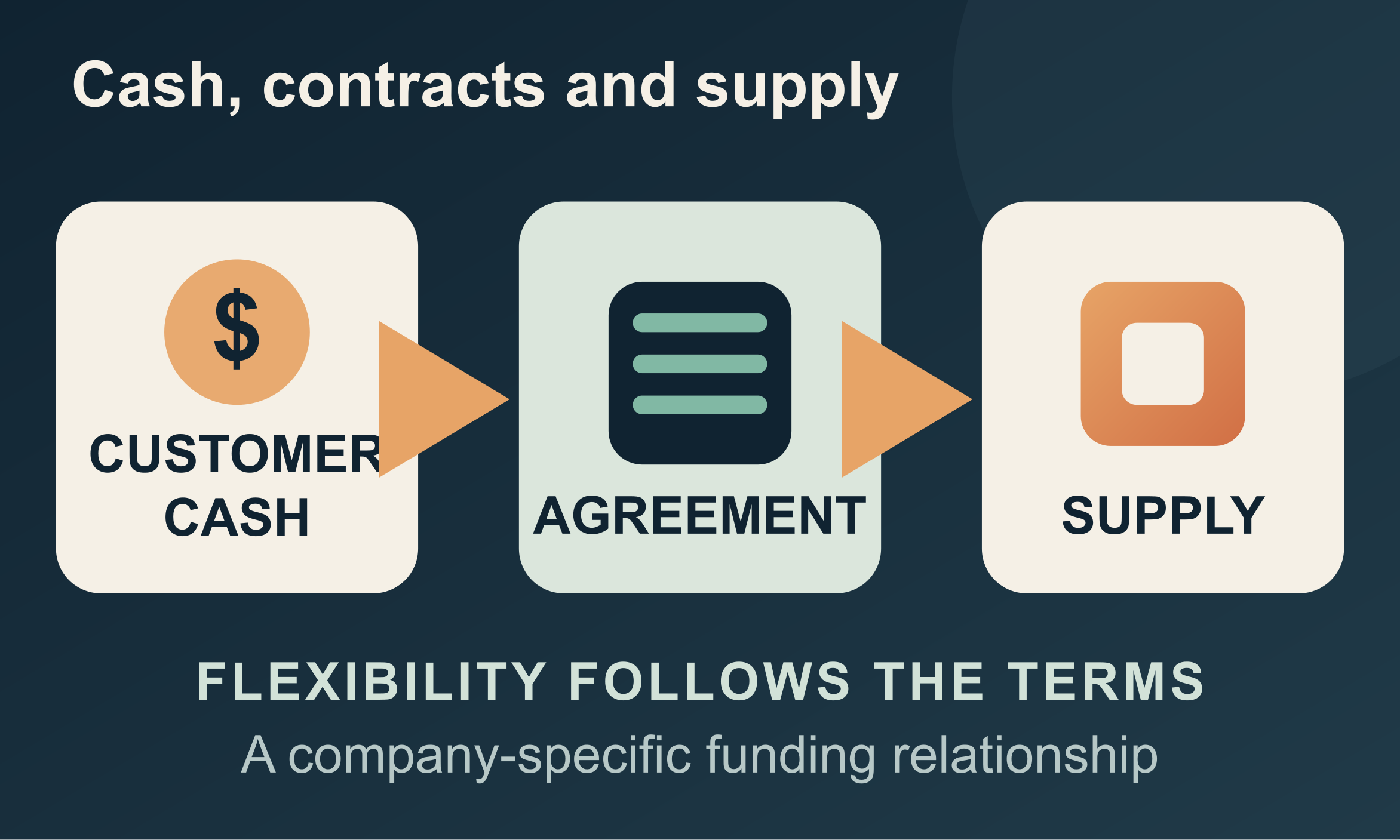
Micron can receive cash today while the reason customers paid it changes tomorrow. Buyers exchange liquidity and purchasing freedom for protection against memory shortages. The value of that protection depends on how long scarcity persists and how well their investment plans progress.
The investment signal is the gap between demand already committed and demand customers would commit afresh. Existing agreements may support shipments even after new commitments become less attractive.
Customer cash shifts the timing of risk
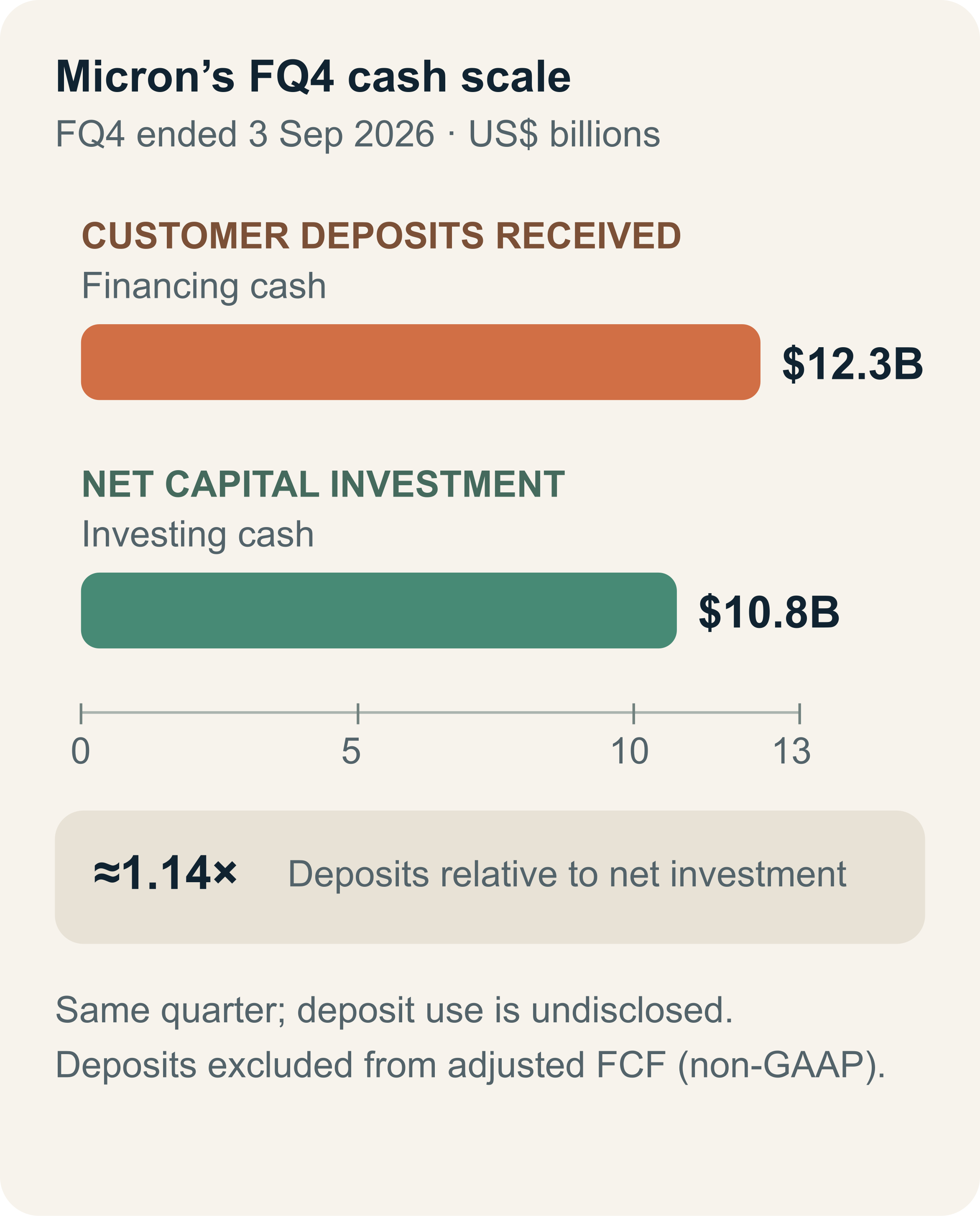
Micron’s fiscal Q4 deposits were about 1.14× its net capital investment: $12.3 billion against $10.8 billion, rounded. The receipts are financing cash excluded from adjusted free cash flow (non-GAAP).
Figure 1
Bars compare Micron fiscal Q4 customer deposits received, $12.3 billion of financing cash, with $10.8 billion of net capital investment in investing cash. Both are for the quarter ended 3 September 2026; the approximate ratio is 1.14 times. Deposit proceeds use is undisclosed, and deposits are excluded from adjusted free cash flow (non-GAAP).
At that scale, the agreements belong in a funding analysis as well as a sales forecast. Customer cash can be valuable even to a supplier able to invest from operations. Its second value is commitment: buyers accept consequences for changing a plan. That can make future demand more credible for capacity planning. Micron’s returns still depend on delivery and the economics of the capacity it builds.
That is a transfer of timing risk. A buyer pays to reduce the chance that unavailable memory will delay a larger investment. When interruption would be expensive, sacrificing liquidity can be rational. If the project slips or alternatives become easier to obtain, the same commitment can make adaptation harder. The question is how much protection the customer continues to receive for the cash and flexibility it surrendered.
Micron’s take-or-pay agreements return deposits over time toward their latter half, provided minimum purchases are met. Liquidity recovery therefore remains connected to execution. A delayed buyer could have less immediate need for memory while its cash stays committed. This is the tension: supply assurance protects a plan and can make that plan harder to revise.
The size of the receipt makes it tempting to count supplier liquidity as further proof of a durable investment cycle. That would overstate what the cash proves. It is a buyer’s commitment arriving upstream, with part of the funding burden still somewhere downstream. If customer funding tightens, old deposits can leave Micron’s cash position looking strong after buyers have become more cautious about new promises. Even a future refund leaves the buyer managing liquidity through the commitment period.
Companywide disclosures leave buyer identities, their funding and agreement-level product allocations undisclosed.
Two monitored price signals sharpen the question
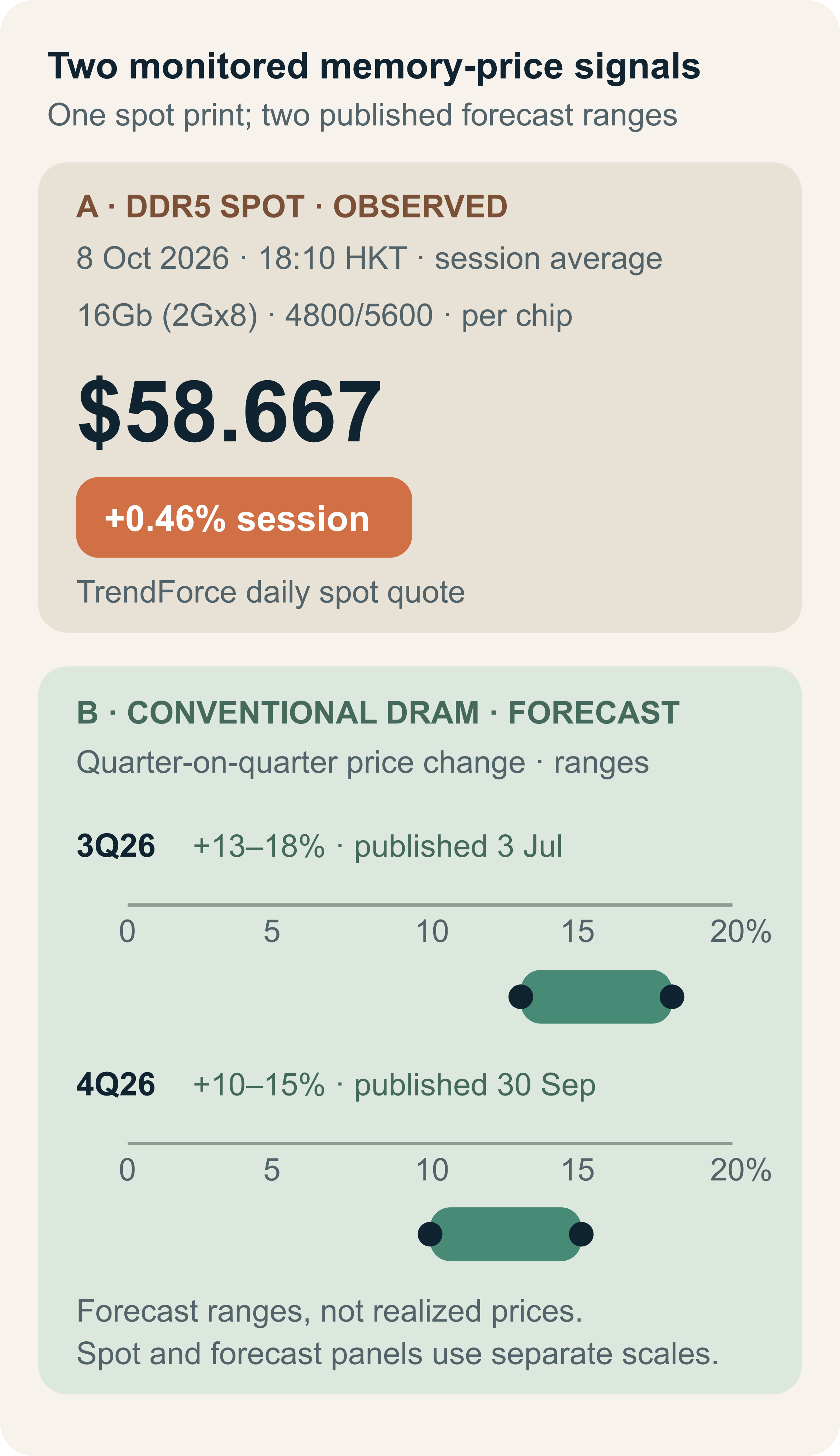
TrendForce’s 8 October DDR5 16Gb spot print was $58.667 per chip, +0.46% for the session. Its broad conventional-DRAM QoQ forecast was +13–18% for 3Q26 and +10–15% for 4Q26. Micron’s own agreement prices remain undisclosed.
Figure 2
Panel A shows one observed TrendForce DDR5 16Gb (2Gx8) 4800/5600 spot session average on 8 October 2026 at 18:10 Hong Kong time: $58.667 per chip, session change +0.46%. Panel B shows conventional DRAM forecasts: 3Q26 +13–18% QoQ, published 3 July, and 4Q26 +10–15%, published 30 September. The panels use distinct measures and scales.
A customer can still face a growing bill even as expected price momentum moderates. That matters because the price paid for certainty and the value of certainty need not move together. A commitment negotiated during greater urgency may become more burdensome without an outright collapse in memory prices.
Investors lose information by reducing this to a bullish or bearish label. A positive forecast can coexist with improving negotiating room for the next agreement. A slower forecast increase can coexist with higher costs for buyers.
Repeated weaker spot readings alongside further forecast moderation would strengthen the case for examining whether new supply insurance deserves the same cash commitment. Continued price pressure would strengthen the rationale for securing delivery.
Existing contracts can delay where a turn appears
Waiting for a revenue decline may miss the first change in customers’ willingness to commit. Obligations already signed can support shipments while a buyer becomes more cautious about the next contract. In that scenario, a strong quarter reflects earlier decisions; new deposits and purchase terms offer a more current view of willingness to accept future risk.
Supply security can also protect volume without protecting the supplier’s return on capacity. If shipments remain firm while realized pricing weakens, investors may see commercially durable demand but less attractive returns. That would shift attention to margins and capacity economics. An agreement may have solved a delivery problem while leaving a profitability problem for shareholders.
A future agreement with less cash upfront and a higher chip price could leave revenue looking stronger while moving more funding risk onto the supplier. A larger deposit paired with a lower price could leave revenue less impressive while improving liquidity before delivery. In either case, the economics would have changed through payment terms as well as price. Investors could misread the supplier’s progress if they treated sales growth as independent of that bargain. Shareholder returns would depend on whether the price compensates for the financing and execution risk the supplier retains.
A decline in new receipts paired with softer obligations would raise a question about demand for future supply assurance.
The later return schedule also makes today’s financing benefit temporary. If qualifying cash returns begin as another capacity programme starts, Micron could face strong shipments and a renewed call on its own operating cash at the same time. The original receipt would have bought time without settling the next funding problem. That timing mismatch could matter more to shareholders than the headline size of cash received earlier.
Funding room is the second test
Memory prices shape the value of shortage protection; customers’ funding room shapes whether they can keep paying for it.
AI Economy Radar’s capex and whole-company free-cash-flow monitors could inform this test once coverage broadens. The current aggregate covers Oracle alone; a broader comparable panel and identified buyers’ disclosures are the next evidence needed.
Funding strength would also change how much bargaining power comes with price relief. A customer able to pay can choose to wait for better terms; a customer short of cash may have to wait even when delay is expensive. The first preserves an option. The second can erode the value of a project before memory demand disappears.
If memory becomes easier to obtain while customers retain ample cash, less appetite for supply insurance need not mean fewer investment plans. A buyer could redirect cash from deposits to construction, networking or other equipment while continuing to buy memory as needed. Micron could retain volumes yet lose some financing or negotiating advantage. In this scenario, weaker new commitments would mark a redistribution of value within the investment cycle: the customer gains flexibility, while the supplier must earn its return through price, cost and execution.
Firm memory prices combined with tighter customer funding would present a different problem. Insurance could remain valuable precisely when the buyer can least comfortably fund it. A smaller new deposit could then reflect a liquidity constraint even if the customer still needs the chips. If that constraint delays implementation, project timelines could stretch without customers having secured cheaper memory. Micron might retain protection from existing obligations yet find customers less able to offer the same cash support for new capacity.
If memory pressure and funding room both weaken, the pressure for flexible terms would come from two directions. The buyer would have less reason to pay for scarcity protection and less room to lock up cash. A supplier might then have to choose between insisting on stronger commitments and preserving the customer’s capacity to keep investing. Accepting more flexibility could protect the customer’s project while moving more timing risk back to the supplier. That would make future revenue more exposed to customer funding than a strong order book alone suggests.
Watchlist — 9 October 2026
- Memory prices: Sustained weaker DDR5 spot prints alongside further conventional-DRAM forecast moderation would make flexibility in new agreements more valuable. Continued price pressure, paired with disclosed delivery constraints, would strengthen the case for securing supply.
- Micron’s next quarterly disclosure: Fewer new deposits paired with looser purchase obligations would raise the question of how much cash buyers still need to pledge for certainty. Scheduled returns after purchase requirements are met would instead be consistent with an agreement working as intended.
- Comparable capex/free-cash-flow update: Cash shortfalls broadening across the tracked companies would increase the importance of preserving liquidity. Paired with easing memory-price pressure, that would make flexible purchase terms more consequential. Identified customers’ disclosures would support testing their funding room.
The investment question is whether new cash and purchase commitments still protect more value than they restrict the buyer’s ability to adapt.
Follow AI Economy Radar’s latest articles as new disclosures test the connection between memory prices, committed cash and investment flexibility.