
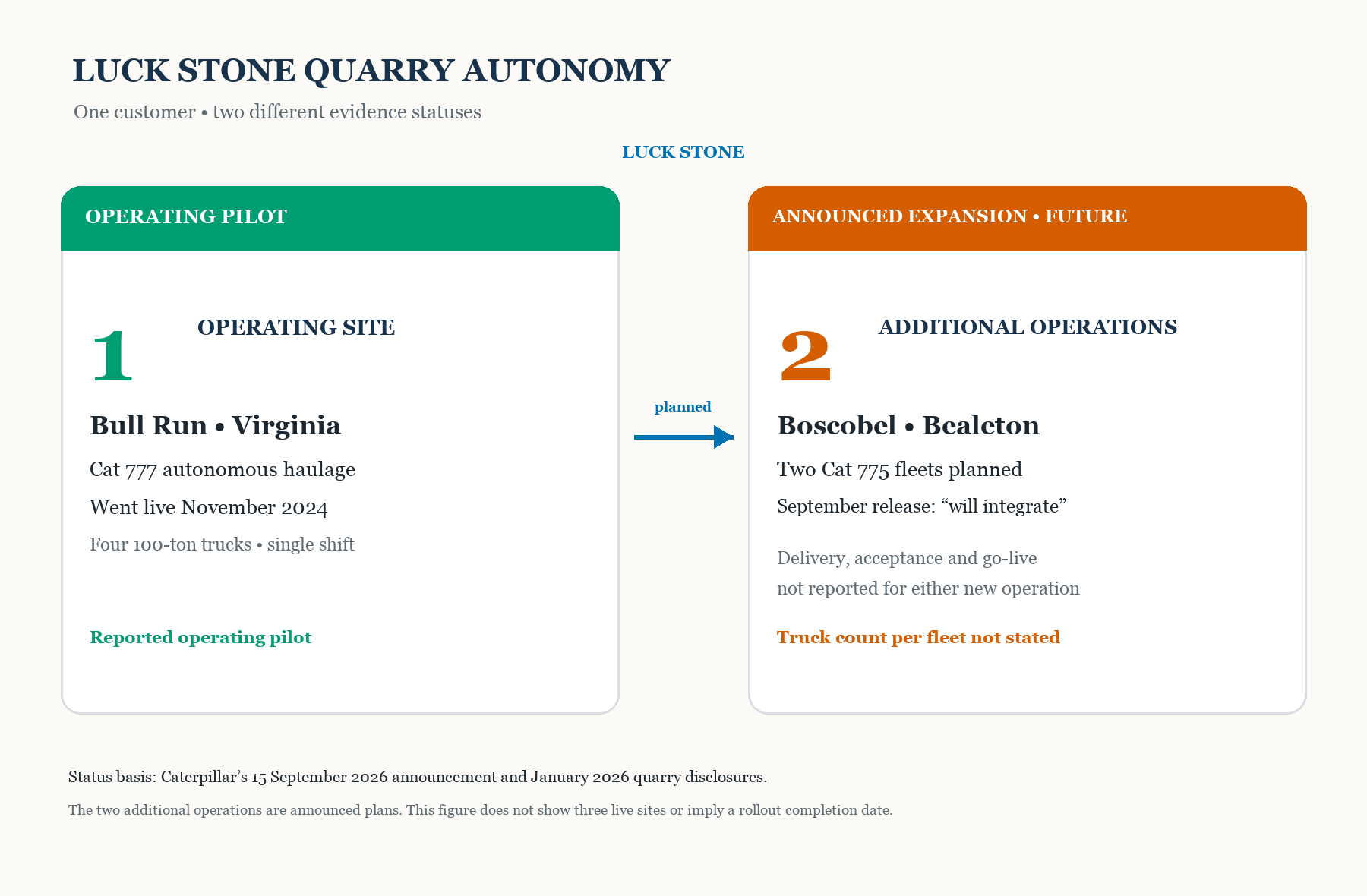
Luck Stone’s planned expansion of Caterpillar autonomous hauling to two additional Virginia operations is a useful industrial-adoption signal. An existing customer is extending an operating quarry pilot to more sites and a different truck model. The evidence combines a working pilot with an announced deployment plan; the two new sites’ operating results remain to be demonstrated.
For investors following industrial hardware and electronics, the next test is whether the implementation can travel across sites with consistent output and manageable support requirements. The announcements document work performed at Bull Run and specify where expansion is planned. They do not provide the contract value, pricing, incremental margin or customer-return calculation needed to value that expansion. S1 S2
One customer, additional sites, a new truck model
Caterpillar’s 15 September 2026 announcement identifies Boscobel and Bealeton as the two additional Virginia operations. The planned expansion will integrate two Cat 775 fleets and will mark the solution’s first deployment on that truck model. Bull Run, which went live in November 2024, used Cat 777 trucks. The future-tense language matters: the announcement does not establish that the additional fleets have been delivered, accepted or put into operation. S1
This is a specific customer’s follow-on deployment decision. It extends the announced footprint and the vehicle-model scope within that customer. A broader market-adoption conclusion would require evidence from additional customers, and a site-performance conclusion would require results from the new operations.
For a hardware investor, the distinction helps keep the signal useful. More deployment opportunities may create demand somewhere in an industrial technology system. These releases neither identify component suppliers nor quantify their procurement. They cannot support a revenue allocation to a particular semiconductor company. S1
Keep the haulage disclosures in their original windows
Caterpillar’s January 2026 account reports that Bull Run reached one million tons hauled by July 2025 and exceeded two million tons in its first year. The September announcement reports more than 3.5 million tons hauled since the November 2024 go-live. Its lead describes more than 18 months of operation, while its headline uses an 18-month pilot description. No exact measurement cutoff or monthly haulage series is supplied. S1 S2
Bull Run’s reported tonnage snapshots
Three separate bars show 1 million tons reached by July 2025, more than 2 million within the first year and more than 3.5 million since November 2024 go-live; the September cutoff is not stated.
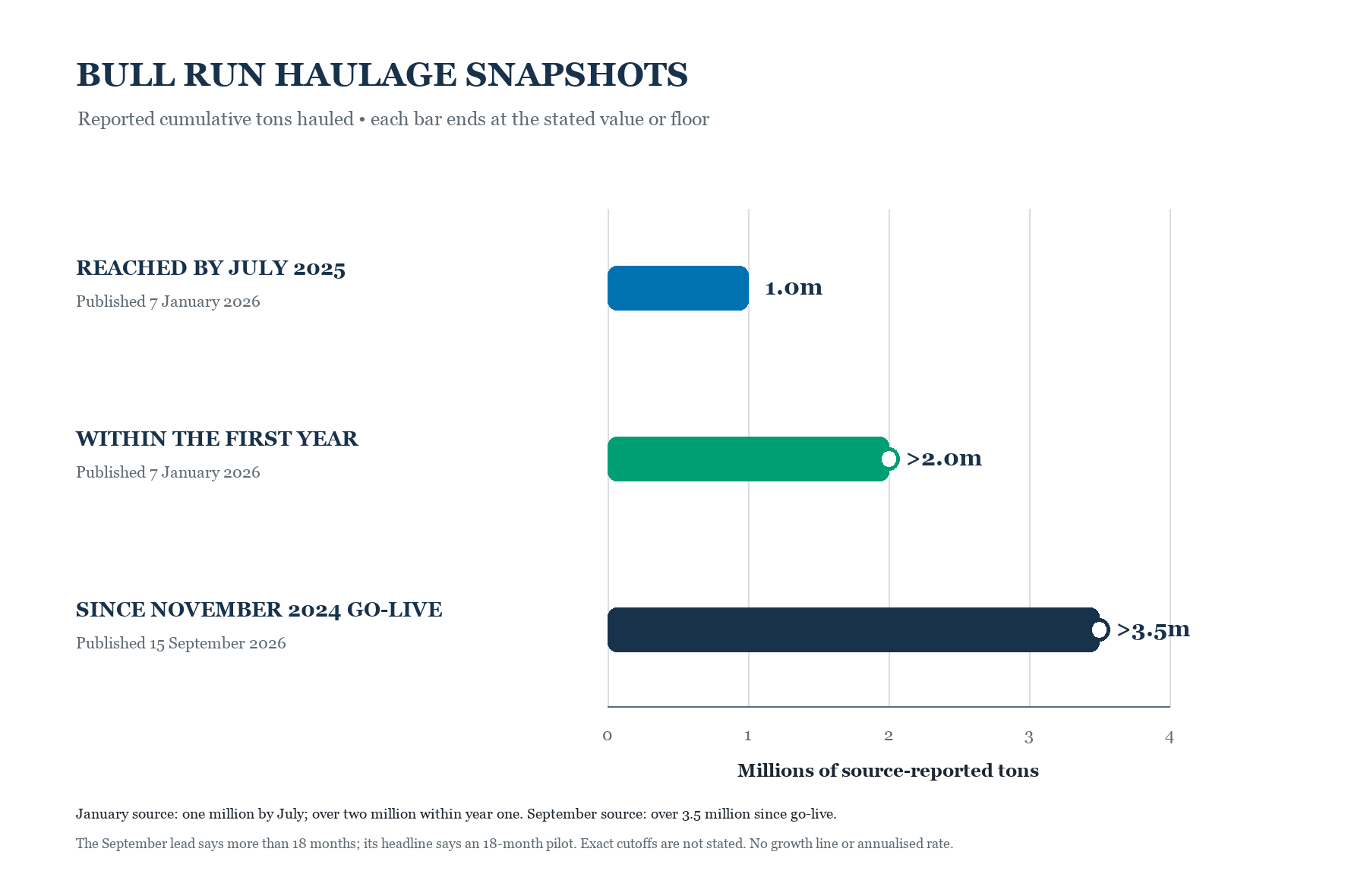
Cumulative tons hauled; separate snapshots, not a time series · Caterpillar-reported Bull Run disclosures published January and September 2026
Select or focus a chart item to read its scope and limitation.
View exact data: Bull Run’s reported tonnage snapshots
| Reported snapshot | Tons hauled | Measurement window | Source publication date | Cutoff / qualifier |
|---|---|---|---|---|
| July 2025 milestone | 1 million tons | Reached by July 2025 | 7 January 2026 | Exact day in July not stated; cumulative haulage. |
| First-year total | >2 million tons | Within first year after November 2024 go-live | 7 January 2026 | Lower-bound wording; exact cutoff not stated. |
| September release cumulative | >3.5 million tons | Since November 2024 go-live; release lead says >18 months while headline says 18-month pilot | 15 September 2026 | Lower-bound wording; precise measurement cutoff not supplied. |
These are company-reported cumulative figures, in the sources’ stated “tons” units. They show machines performing work. They do not measure revenue, utilisation per available hour or savings per ton. Dividing the last figure by 18 months would manufacture a precise rate from an imprecise reporting window. The chart therefore shows the disclosures without a connecting growth line or an annualised estimate.
Caterpillar’s global autonomous-mining fleet totals describe a different operating population. They should not be counted as quarry deployments or added to Bull Run’s haulage. S3
One operating pilot, two announced sites
One operating Luck Stone site at Bull Run uses Cat 777 trucks; Boscobel and Bealeton are two announced additional operations planned for Cat 775 fleets, with delivery and go-live unreported.
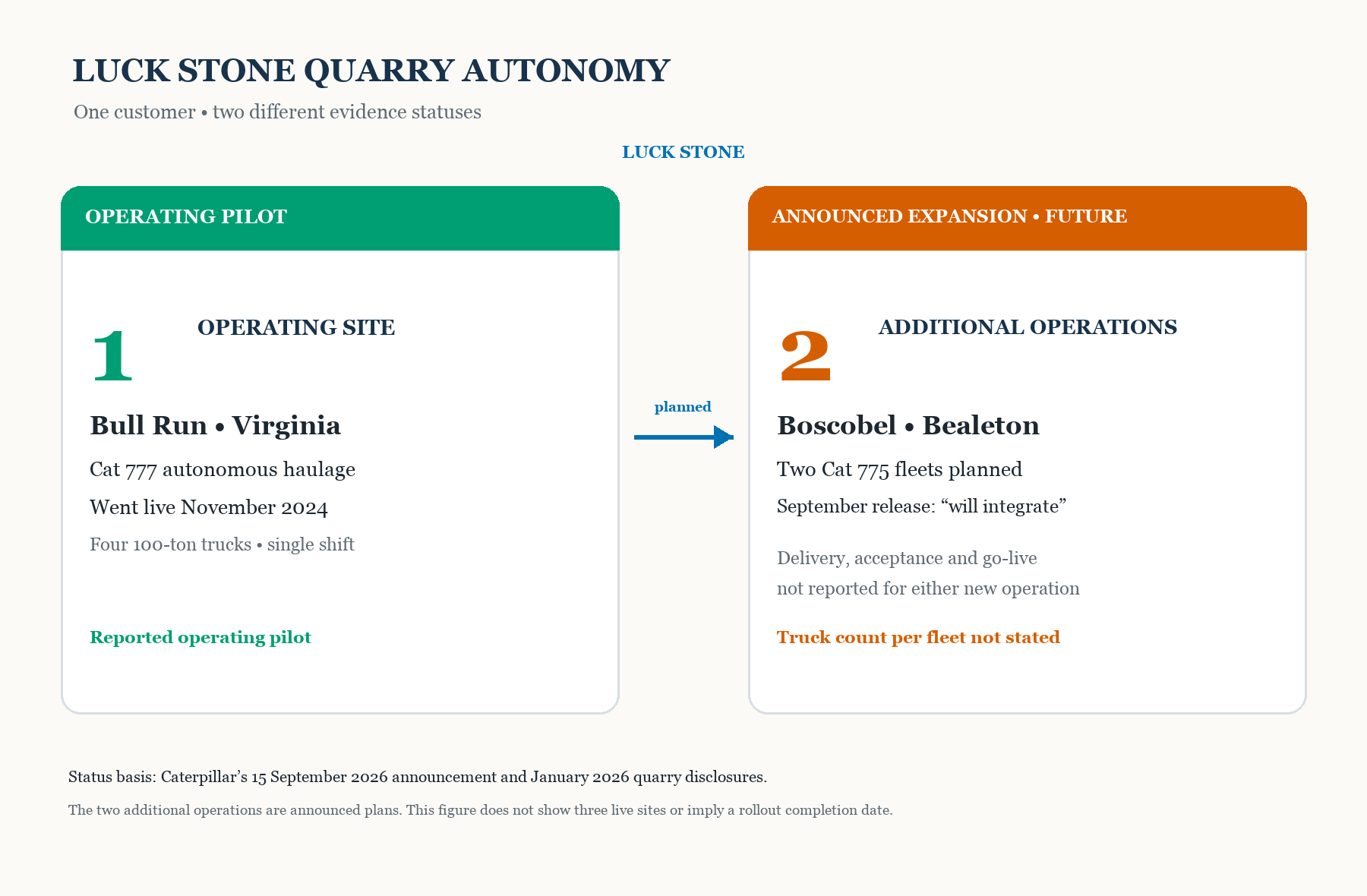
Operating and announced status described through 15 September 2026 · One customer; pilot vs announced expansion
Select or focus a chart item to read its scope and limitation.
View exact data: One operating pilot, two announced sites
| Phase | Site(s) | Status | Truck model | Fleet / truck count | Go-live | Evidence limit |
|---|---|---|---|---|---|---|
| Pilot | Bull Run | Operating | Cat 777 | 4 trucks; 100 tons each | November 2024 | Caterpillar does not disclose the productivity comparison method or window. |
| Expansion | Boscobel; Bealeton | Announced future | Cat 775 | 2 fleets; truck count not stated | Not stated | No delivery, acceptance or go-live evidence for either additional operation. |
Implementation support belongs in the adoption test
The initial quarry configuration provides useful context: Caterpillar describes four 100-ton Cat 777 trucks operating on a single shift. It reports that productivity matched staffed machines shortly after go-live, but does not provide the comparison method, observation window or staffing-cost calculation. S2 S3
Caterpillar describes simplifying MineStar configuration and training for the quarry, with its own team supporting implementation at Bull Run. It presents these changes as helping reduce implementation time and cost, without quantifying the savings. These details show that the pilot involved operational adaptation as well as equipment. S2 For the announced expansion, the September release identifies Caterpillar as delivering the solution with support from local dealer Carter Machinery; that is a statement about the future rollout. S1
Replication should be assessed with that work included. Relevant questions are how long the next site takes to reach stable operation, what support it requires, how output is measured and how downtime is handled. Implementation support may be temporary; the sources do not establish the long-run support burden. Neither favourable nor unfavourable economics can be calculated from its presence alone.
Luck Stone’s corresponding announcement confirms the customer’s participation, but largely reproduces the joint release. It is not a separate productivity audit. S4
The financial bridge remains unreported
The relevant financial question is how an additional deployment converts into paid products and services, when revenue is recognised, and what costs accompany it. The announcements reviewed do not answer those questions. They disclose no contract price, payment structure or separate quarry-autonomy revenue. S1 S4
The useful distinction is between deployment evidence and valuation inputs. The former has become more specific: named additional operations and a new truck model. The latter still needs directly linked commercial and cost disclosures.
What to watch after 8 October 2026
The next disclosures can sharpen the case in four ways:
- Site status: named go-live dates, fleet counts and evidence of sustained operation at Boscobel and Bealeton.
- Comparable performance: a stated measurement window and consistent definitions for output, operating hours, downtime and implementation support.
- Customer breadth: deployments at customers beyond Luck Stone, with their operating conditions identified.
- Commercial visibility: disclosed pricing or contract structure, deployment-linked revenue and a customer cost-and-benefit calculation.
These checkpoints separate the work already reported at Bull Run from what the announced rollout still needs to demonstrate. A stronger investment case would link repeated operating results to observable commercial outcomes.
Sources
- S1. Caterpillar Investor Relations, “Luck Stone Builds on Autonomous Hauling Success with Caterpillar,” 15 September 2026
- S2. Caterpillar, “Scaling a Proven Autonomy System to Support New Industries,” 7 January 2026
- S3. Caterpillar, “Cat Autonomy Solutions,” 7 January 2026
- S4. Luck Stone, “Luck Stone Builds on Autonomous Hauling Success with Caterpillar,” page dated 18 September 2026; release dateline 14 September