
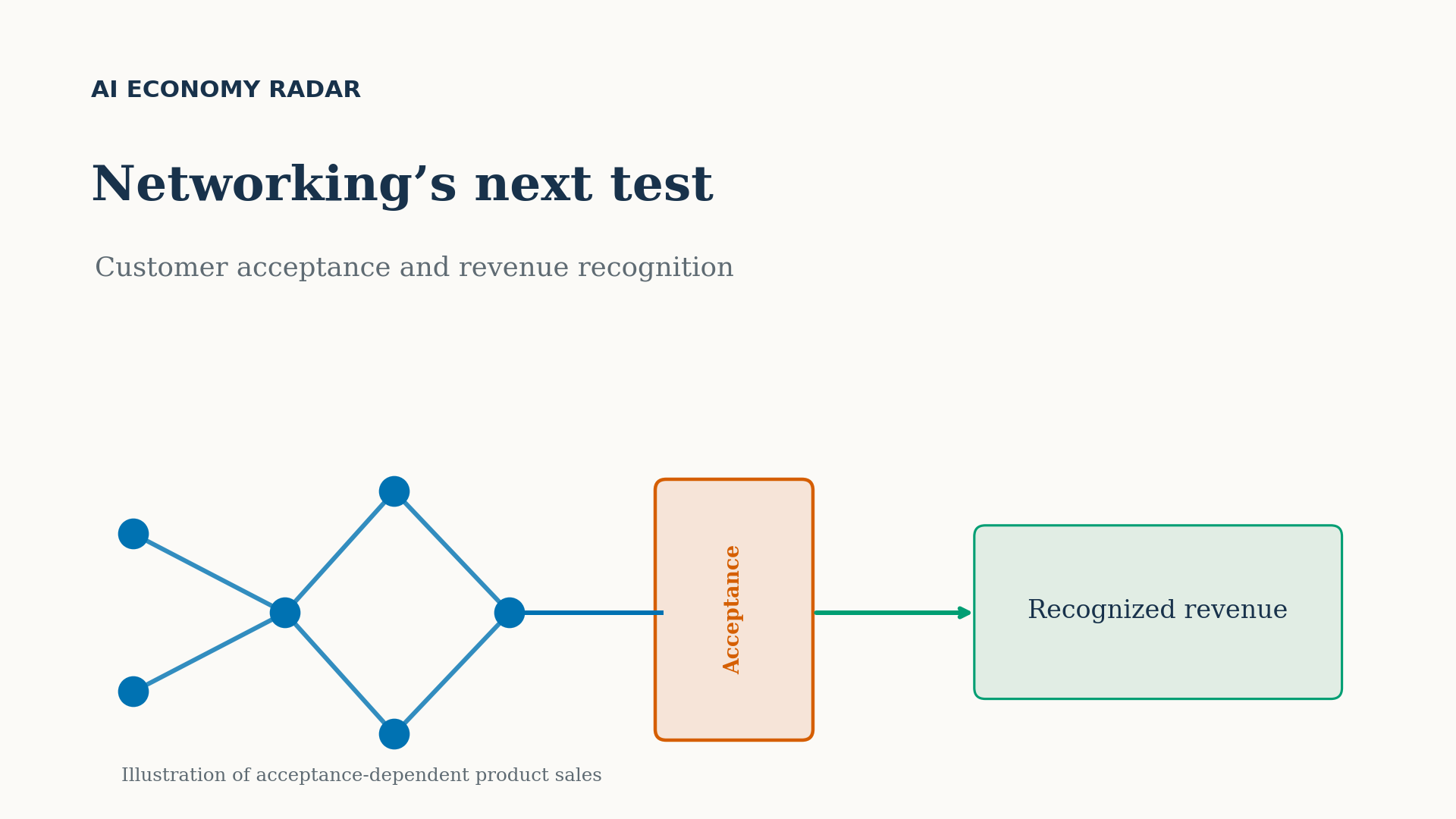
Arista’s growth leaves investors with a conversion question: how will today’s unrecognized obligations reach the income statement? A growing deferred balance can support the revenue outlook while increasing its dependence on the mix of contracts and the progress of customer acceptance. The next useful signal is how that balance moves through the business.
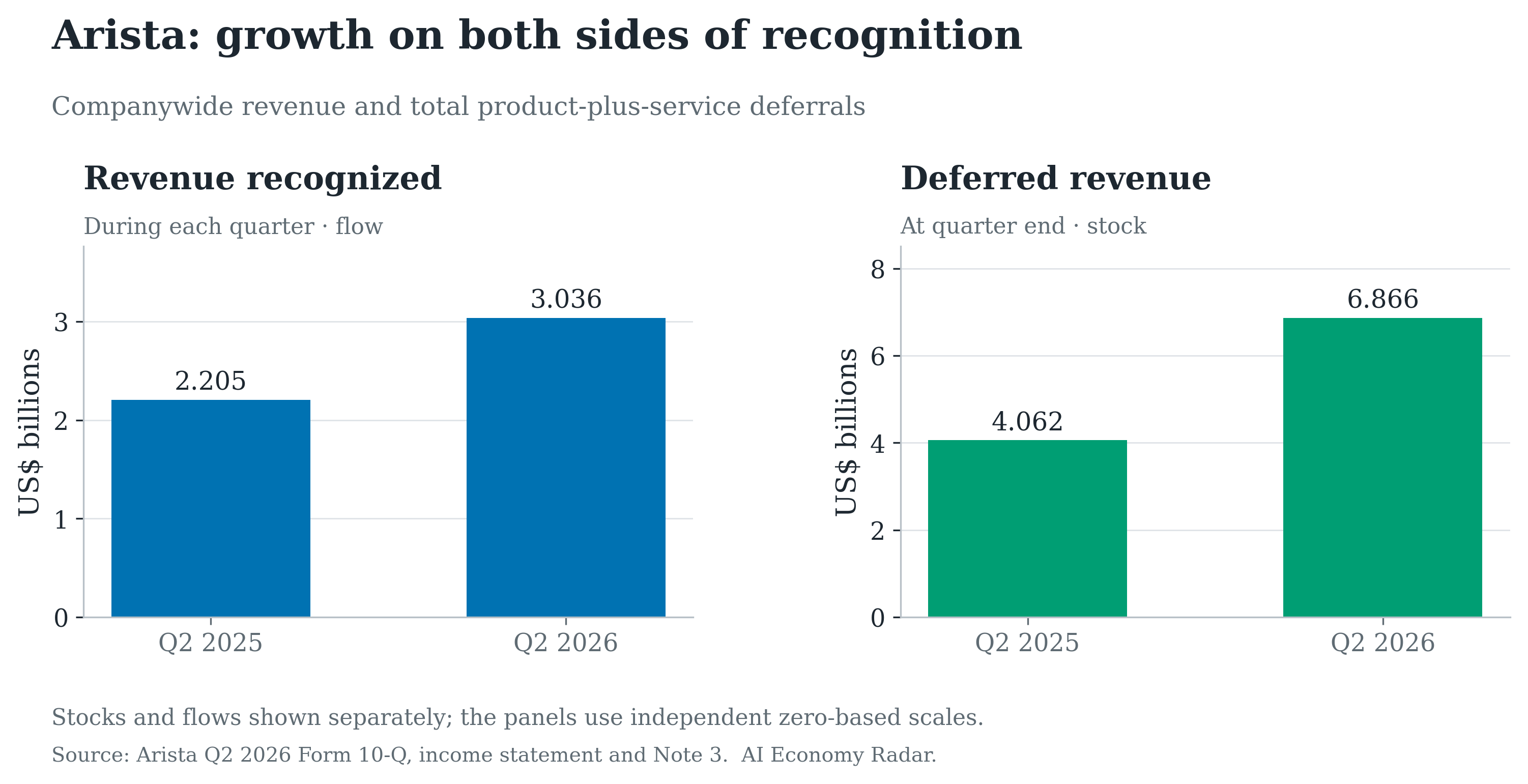
Q2 2026 company revenue reached $3.036 billion, up 37.7% year over year. Total deferred revenue ended June at $6.866 billion, up 69.0% from a year earlier, calculated from the filed balances. The pool mainly combines multi-year support obligations and product contracts with acceptance clauses. [1]
That combination matters for the AI-networking thesis. A supplier can win business, ship equipment and still face a further test before recognizing some product revenue. Investors who put the same confidence in every dollar of the deferred balance could overestimate near-term conversion. Investors who treat every increase as deployment friction could miss fresh business arriving while earlier obligations are being fulfilled.
Figure 01
Separate zero-based panels show Arista Q2 2025 and Q2 2026 company revenue of $2.205 billion and $3.036 billion, and quarter-end combined product-and-service deferred revenue of $4.062 billion and $6.866 billion. The panels use independent scales.
Acceptance changes the revenue timing
Arista generally recognizes hardware revenue at shipment. For new products or use cases with substantive customer-specified acceptance requirements, recognition waits until those requirements are met. Support revenue is recognized over the contract term. [2] Its Q2 filing connects expanded use cases, particularly AI Ethernet, with more trials and acceptance periods and greater variability in product deferrals. [1]
This creates two different investment questions inside the same reported balance. Support obligations ask whether an installed customer relationship keeps producing service revenue. Acceptance-dependent products ask whether a deployment satisfies its agreed requirements. Growth in either can enlarge the pool, while the next step needed to earn the revenue differs.
For AI networks, acceptance also puts execution alongside demand in the investment case. A customer’s willingness to order equipment and its ability to approve a deployment answer different questions. If successful validation leads to repeat deployments, a period of deferred recognition could precede a more durable commercial relationship. If requirements prove difficult to meet, a strong shipment pipeline could coexist with weaker conversion into revenue.
The distinction changes how to assess an earnings surprise. A quarter helped by acceptance of earlier deployments may bring forward recognition without establishing the same pace of fresh demand. A quarter with slower recognition could preserve future opportunity if customers continue advancing toward acceptance. The investment response should depend on the underlying progress, rather than the direction of the balance alone.
The balance grew while earlier obligations became revenue
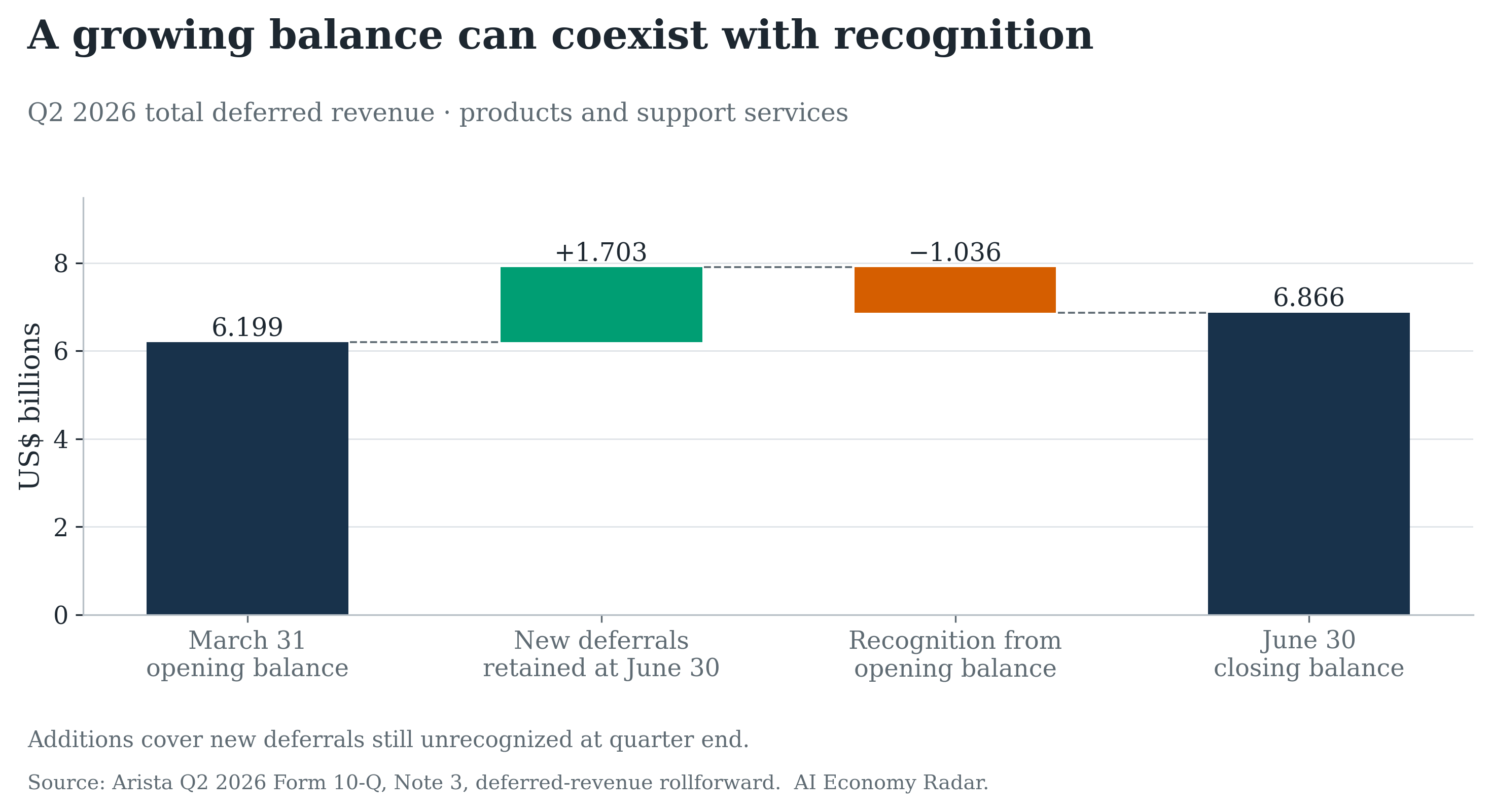
During Q2, Arista recognized $1.036 billion from its opening deferred balance and added $1.703 billion of new deferrals still unrecognized at quarter end. Those movements took the combined pool from $6.199 billion to $6.866 billion. [1]
The useful tension is that recognition and accumulation occurred together. A larger closing balance therefore leaves room for both a healthy inflow of business and unresolved acceptance work. The rollforward demonstrates activity in the pool; a product-and-support breakdown would show how much of that activity came from customer validation versus service delivery.
Figure 02
Arista’s Q2 2026 combined deferred revenue moves from $6.199 billion at March 31, plus $1.703 billion of new deferrals retained at June 30, less $1.036 billion recognized from the opening balance, to $6.866 billion at June 30. Additions exclude amounts recognized during the quarter.
A successful acceptance wave could reduce product deferrals while lifting recognized revenue. A reader focused on the shrinking balance might call that a loss of visibility, even as the business was fulfilling its obligations. The stronger test would be whether new deployments replace the accepted work and whether the revenue carries attractive economics.
The opposite pattern deserves equal attention. Support renewals could help enlarge the combined balance while product acceptance becomes more difficult. A reader focused on total growth might then assign greater confidence to a pool whose product component needs closer scrutiny. Changes in composition could matter more than a change in the headline growth rate.
This is why a recognition-to-opening-balance ratio would have limited value for the product thesis. The pool combines obligations earned through different processes. Investors would learn more from comparable disclosures about product acceptance, support activity and repeat customer deployments than from extrapolating a timetable from the aggregate.
Earnings quality depends on what converts
Acceptance affects the confidence investors can place in future earnings. More dependable recognition could make the business easier to forecast and reduce the range of outcomes attached to a deployment. That would strengthen the case for treating a growing commercial pipeline as an earnings opportunity. A larger balance with less clarity on acceptance would leave a wider range of possible outcomes.
Arista’s Q2 filing also links higher product deferrals with increased deferred cost of sales. [1] The product’s eventual revenue therefore comes with associated costs. An acceptance-led revenue increase should be assessed alongside the margin earned on the work and the resources required to deliver it.
If validation becomes more demanding as networks grow more complex, a supplier could retain demand while spending more effort to complete each deployment. That would make implementation capability more consequential to returns. If earlier work helps customers approve later deployments more smoothly, the same capability could instead support repeat business and more predictable earnings. These are competing operating paths that future disclosures can help distinguish.
Cash adds a separate timing question. New deferrals and recognition describe changes in unearned obligations; collections, receivables and related costs help explain the funding of those obligations. An investor assessing earnings quality should look for commercial progress that is accompanied by sound collection and delivery economics. A favorable revenue quarter can carry different implications depending on those cash demands.
The strongest counterpoint is the revenue already earned
Arista’s reported revenue growth gives the optimistic case a concrete starting point. Business is reaching the income statement, and the deferred pool also generated recognition during Q2. That evidence supports taking the commercial opportunity seriously. It leaves the acceptance question focused on the quality and timing of the remaining opportunity.
Fresh deployments could keep the balance growing even as customers approve earlier products. In that case, accumulation would be consistent with expansion rather than a worsening execution problem. Product-specific disclosures and comparable acceptance commentary would make that reading more persuasive. The same disclosures would also help identify a change in delivery conditions before it dominates companywide results.
The investment case could strengthen with a smaller deferred balance if successful acceptance, repeat orders and attractive margins appeared together. It could weaken with a larger balance if more difficult validation reduced the probability or economics of recognition. Investors gain a better decision framework by following the sequence of customer progress and commercial replenishment.
What to watch on 3 November
Arista has scheduled Q3 results for 3 November 2026 after the U.S. market close. [3] Three checks would sharpen the investment reading:
- Revenue and the deferred rollforward together. Recognition from the opening balance, new retained deferrals and the closing stock will show how activity changed. A falling balance paired with stronger revenue would make successful fulfillment a useful explanation to test; a rising balance would make the sources of additions more consequential.
- Acceptance progress and contract mix. Comparable discussion of trials, requirements and product deferrals would help distinguish fresh deployments from work taking longer to complete. A separate support-and-product breakdown would improve confidence in either interpretation.
- Margins, collections and repeat deployments. Evidence that accepted work earns attractive margins, collects well and leads to further customer business would strengthen the return case. Higher implementation costs or tougher acceptance requirements would place more weight on delivery economics.
The question for shareholders is how much confidence to assign to the next dollar of recognition. Following acceptance, replenishment and profitability together can turn a large deferred balance into a more useful test of the AI-networking thesis.
Follow AI Economy Radar’s latest articles for source-linked research on AI demand, supply and funding.
Sources
[1] Arista Networks, Q2 2026 Form 10-Q, filed 5 August 2026. Income statement, p. 2; deferred-revenue rollforward, Note 3, p. 9; acceptance discussion, p. 15; cash-flow discussion, p. 19.
[2] Arista Networks, 2025 Form 10-K, filed 17 February 2026. Revenue-recognition policy, Note 2, pp. 76–77.
[3] Arista Networks, Q3 2026 results announcement, 6 October 2026.