
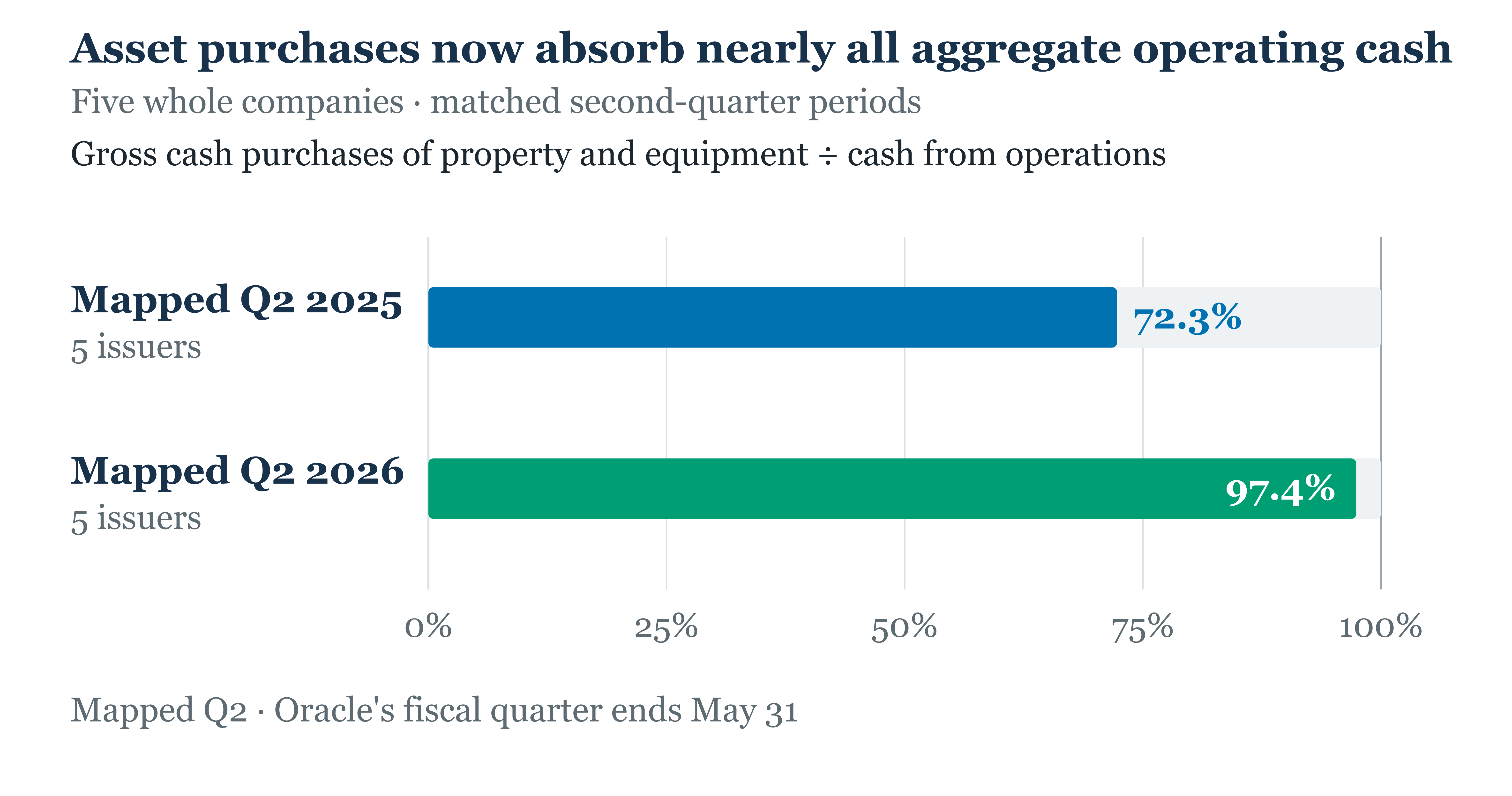
Five major AI infrastructure providers generated enough operating cash, in total, to cover their cash purchases of property and equipment. Three of them spent more on those assets than their own operations brought in.
Across Amazon, Alphabet, Microsoft, Meta and Oracle, those purchases absorbed 97.4% of aggregate operating cash flow in mapped Q2 2026, up from 72.3% in the matched 2025 quarter. The apparent balance comes from adding together cash that belongs to different companies.
Figure 1
Two-bar comparison of five-issuer gross cash property-and-equipment purchases over operating cash flow: 72.3% in mapped Q2 2025 and 97.4% in mapped Q2 2026, with a 0% to 100% axis.
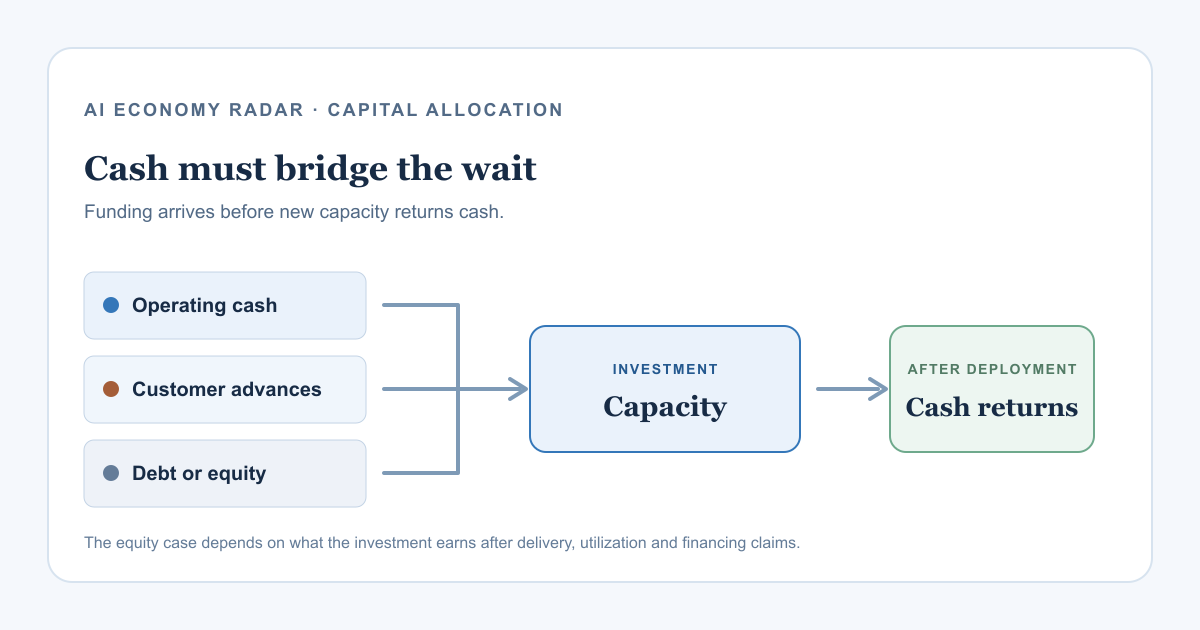
Each issuer must carry its own investment program. The way it obtains the cash changes what future performance must cover—and what can ultimately remain for shareholders.
The aggregate hides the funding decision
Cash PP&E purchases exceeded operating cash flow at Amazon, Alphabet and Oracle. Operating cash flow exceeded those purchases at Microsoft and Meta.
For companies above that line, the investment case needs an account of how the spending is being carried. Reserves commit accumulated cash; borrowing adds interest and repayment claims; new shares change the equity base over which eventual returns are spread. Customer advances introduce another source: cash arrives alongside obligations to perform later.
Demand matters through its payment terms as well as its volume. A customer commitment can improve future revenue visibility while increasing the cash needed to deliver it. If customers pay before delivery, that demand can also help fund deployment. The investment thesis should identify which cash timing it assumes.
Operating cash flow can arrive before the payoff
Oracle's later quarter, ended August 31, provides a concrete example. Its cash-flow reconciliation included an $11.363bn increase in deferred revenue from customer prepayments with a significant financing component. The filing says customers paid before corresponding performance obligations were delivered and that these financing components are reflected in deferred revenue and recognized over the period of performance. Oracle Q1 FY2027 filing
This August-quarter example is separate from the matched Q2 comparison. The same filing also reports net cash proceeds from ATM share issuances for general corporate purposes. Customer funding and equity funding can coexist with stronger reported operating cash flow.
Advances can help finance a deployment before its performance is complete. Their value to equity depends on the cost and timing of delivering what has already been paid for. Stronger operating cash flow can improve the funding position while leaving the capacity's operating economics to be established.
The valuation implication is concrete: a prepayment's cash benefit and its delivery obligations belong in the same forecast. Investors need to distinguish cash from ongoing operations, payments brought forward and capital raised. Those sources can all keep expansion moving, but they support different claims about the progress of the investment.
What bond prices change
On October 2, the selected hyperscaler basket's weighted average yield-minus-SOFR reading was 164 basis points. The selected Oracle/CoreWeave basket averaged 366 basis points on the same calculation basis. Oracle accounts for 88% of the latter basket's fixed original-issue-size weight.
Figure 2
Two selected-note baskets on October 2, 2026: a six-note hyperscaler weighted average at 163.954342 basis points and a five-note Oracle plus CoreWeave weighted average at 365.990510 basis points; Oracle is 88% of the second basket by fixed original issue-size weight.
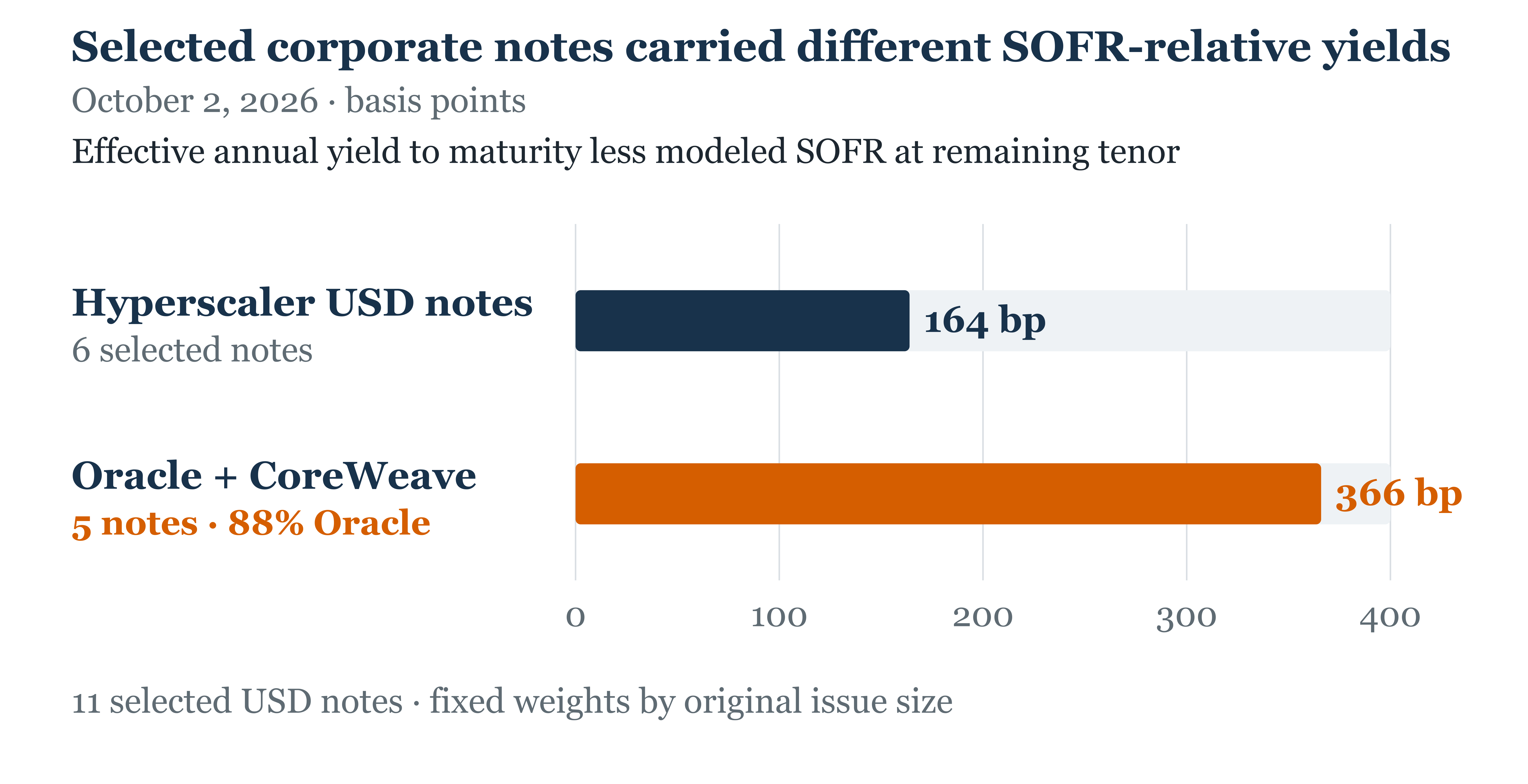
The selected prices identify where to scrutinize the next funding transaction. For a company relying on outside cash, actual issuance and refinancing terms determine the contractual cost of carrying the investment program. Existing fixed-rate coupons continue under their contracts; today's market readings bear on additional or replacement funding.
The practical use is to examine new transactions against comparable rates, maturities and terms, then put the cash claims the provider actually takes on into the forecast. The basket gap alone leaves the competitive effect open: an ability to sustain lower pricing or a longer ramp would need transaction and operating evidence.
What should change an investor's view
As of October 9, three developments would change this assessment over the next two reported quarters:
- Cash-flow improvement has an operating explanation. An improved cash PP&E/operating-cash-flow ratio alongside disclosed operating progress at deployed capacity would strengthen the return case. Improvement driven mainly by fresh prepayments, lower investment or delayed payments changes the funding timeline; it needs a separate explanation of the underlying operating returns.
- Customer-funded commitments become completed performance. Delivery and recognition of performance obligations help establish that cash received early has been converted into the work promised. Delays or higher fulfillment costs would reduce the appeal of an unchanged return forecast.
- Actual financing fits the cash program. New borrowing terms, share issuance and funding disclosures show how each issuer is carrying expansion. A wider funding gap, worse incremental terms, or a growing equity base without corresponding improvement in capacity economics would weaken the expected per-share payoff.
A buildout can be funded before its equity payoff is established. The next reports should be judged by who provided the cash, what was delivered, and what those delivery and funding obligations leave for shareholders.
Follow AI Economy Radar for updates on the evidence that changes this view.
Measure and sources
Cash PP&E/operating cash flow divides summed whole-company gross cash purchases by summed operating cash flow, using discrete quarters from SEC filings. Asset-sale proceeds are not deducted; lease principal and noncash additions are excluded. The measure does not isolate AI investment. The later Oracle example is a separately dated whole-company cash-flow and funding disclosure.
Selected-note values are original-issue-size-weighted averages of effective annual yield less interpolated same-date SOFR swap rates. Calculations use closing prices, documented payment terms, next-weekday settlement and remaining maturities. The existing notes differ in credit, tenor, liquidity and call terms; the readings are modeled secondary-price metrics.
### Sources
- SEC cash-flow filings for the matched-Q2 comparison: Amazon Q2 2026; Alphabet Q2 2026; Alphabet Q1 2026; Meta Q2 2026; Meta Q1 2026; Microsoft FY2026; Microsoft Q3 FY2026; Oracle FY2026; Oracle Q3 FY2026.
- Separate Oracle Q1 FY2027 cash-flow and customer-prepayment disclosure: Oracle Q1 FY2027 Form 10-Q.
- Official original issue terms for selected notes: Meta 2025 prospectus supplement covers the 4.875% notes due 2035 ($6.5bn) and 5.750% notes due 2065 ($4.5bn); Alphabet November 2025 term sheet covers the 4.700% notes due 2035 ($3.5bn); Alphabet April 2025 term sheet covers the 5.300% notes due 2065 ($1.5bn); Amazon November 2025 term sheet covers the 4.650% notes due 2035 ($3.5bn); Microsoft 2021 Form 8-K covers the 2.921% notes due 2052 ($6.25bn), issued in settlement of exchange offers; Oracle 2025 prospectus supplement covers 4.450% notes due 2030 ($3.0bn), 5.200% notes due 2035 ($4.0bn), 5.950% notes due 2055 ($3.5bn) and 6.100% notes due 2065 ($2.0bn); CoreWeave 2025 indenture and note form covers the initial 9.000% notes due 2031 ($1.75bn).
- Selected note closing prices, October 2: Meta 4.875% due 2035; Meta 5.75% due 2065; Alphabet 4.7% due 2035; Alphabet 5.3% due 2065; Amazon 4.65% due 2035; Microsoft 2.921% due 2052; Oracle 5.2% due 2035; Oracle 6.1% due 2065; CoreWeave 9% due 2031; Oracle 4.45% due 2030; Oracle 5.95% due 2055.